
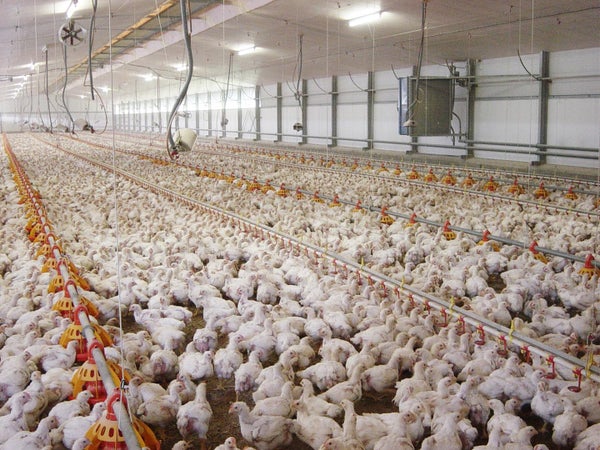

Hundreds of millions of years from now, when humans are probably long gone, what sort of geologic record will we leave behind for future archaeologists? Plastics, sure? Concrete, maybe? How about:
Yep, chicken. Humanity consumes some 66 billion birds a year. Billion, with a B. The mass of chickens on the Earth is so big… it beats the mass of all other birds combined.
"The numbers are astonishing." Richard Thomas is an archaeologist at the University of Leicester, who writes with his colleagues in the journal Royal Society Open Science that chicken bones could be a unique signifier of our era…known as the 'Anthropocene.'
On supporting science journalism
If you're enjoying this article, consider supporting our award-winning journalism by subscribing. By purchasing a subscription you are helping to ensure the future of impactful stories about the discoveries and ideas shaping our world today.
[Carys E. Bennett et al., The broiler chicken as a signal of a human reconfigured biosphere]
Thomas says our chicken-industrial complex can be traced back to a program in the late 1940s, called the "Chicken-of-Tomorrow" program.
"They came up with this fast-growing meat chicken." Then, in the decades to come, selective breeding, gene editing, antibiotics and new types of feed and housing helped maximize chickens' weight gain even more. "The chickens of today are something like four times heavier than the original broiler chickens of the 1950s."
The upshot, he says, is these bigger-boned broilers are huge compared to the wild red jungle fowl they're descended from. And modern chickens will stand out in the fossil record, for their size and especially their ubiquity.
"We're gonna find these huge middens, as we'd call them archaeologically, these huge rubbish heaps that are gonna be filled with the fossilized remains of chickens. And they're going to be the overwhelming animal species we find."
And that, folks, may be the foremost legacy that human greatness leaves behind. And all without solving one of the most enduring mysteries of all.
—Christopher Intagliata
[The above text is a transcript of this podcast.]
