
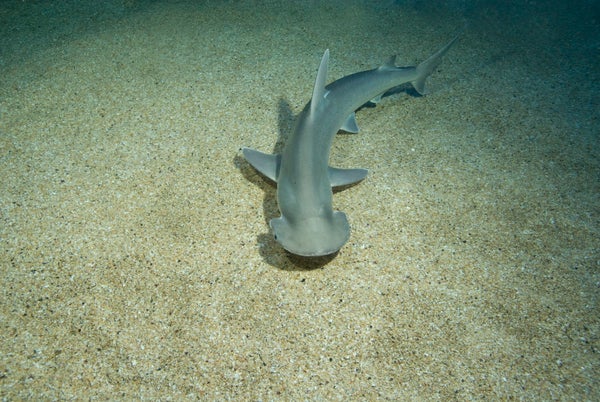

Sharks aren't typically thought of as vegetarians. Or even omnivores. But about 10 years ago, scientists documented a dainty relative of the hammerhead shark, known as a bonnethead shark, consuming copious amounts of sea grass.
"A lot of people kind of just thought they were consuming it incidentally, after going after crabs and squid and other little invertebrates that live in the sea grass meadows." Samantha Leigh, a PhD candidate at the University of California, Irvine. "So everyone thought they were kind of just passing it through their system and not really getting anything from it."
So Leigh and her colleagues hauled five of the small sharks back to a Florida lab, and put them on a three-week diet: 90 percent sea grass, 10 percent squid. And analyzed the digestibility of that diet. Turns out, the sharks actually put on pounds, and were able to digest the sea grass just as well as young green sea turtles do.
On supporting science journalism
If you're enjoying this article, consider supporting our award-winning journalism by subscribing. By purchasing a subscription you are helping to ensure the future of impactful stories about the discoveries and ideas shaping our world today.
"It seems like even though the bonnethead shark has what scientists would deem a carnivorous gut, they are definitely acting like omnivores. So there's probably something going on, on probably a microbial level, that's helping them break down this sea grass."
The full nutrition info is in the Proceedings of the Royal Society B. [Samantha C. Leigh et al., Seagrass digestion by a notorious ‘carnivore’]
The study also gives coastal ecosystem managers something new to chew on: these sharks are like lawn mowers, trimming the sea grass, digesting it, and, yes, recycling it. "So they likely play more of a stabilizing role in food web dynamics. They're not a top apex predator. And they're probably playing a large role in nutrient transport in those sea grass meadow ecosystems as well."
As for whether we might convince more sharks to have a side salad with dinner? "I don't know that we'll be able to do that anytime soon."
—Christopher Intagliata
[The above text is a transcript of this podcast.]
