
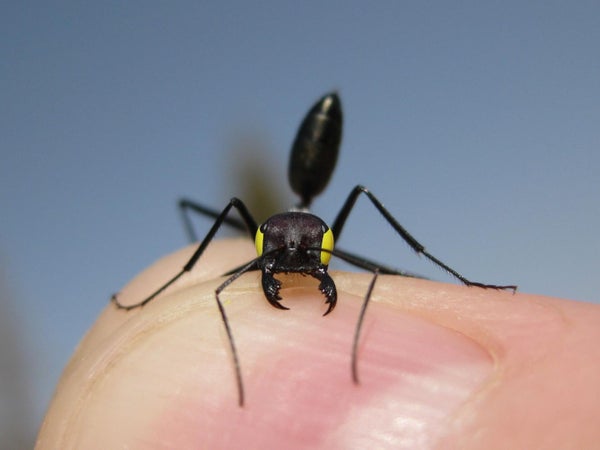

Make a left at the big oak tree about a mile down the road. That kind of direction is common in landcapes filled with visual cues. But the Sahara desert is a much tougher place to navigate. Even any footprints you leave get erased as winds massage the sand. Nevertheless, ants in the desert go on searches for food—and once they find it they carry their prize directly back to the nest.
In the late 1980’s, researchers discovered that the ants can achieve this impressive feat using a process called path integration. To gauge the direction home, they keep track of the sun's motion across the sky—just like sailors used to do. To calculate the distance, they count their steps.
"It's a very hostile environment. They're foraging at the hottest times of the day and it’s a desert, so surface temperatures reach 60 to 70 degrees Celsius."
On supporting science journalism
If you're enjoying this article, consider supporting our award-winning journalism by subscribing. By purchasing a subscription you are helping to ensure the future of impactful stories about the discoveries and ideas shaping our world today.
Neurobiologist Matthias Wittlinger from Germany's Ulm University, on the podcast of the journal Science, which published this work. [Sarah E. Pfeffer & Matthias Wittlinger. Optic flow odometry operates independently of stride integration in carried ants.]
"And they need to be really quick in finding food, and they really need to be very quick in getting the food back to the nest…they need to be really fast, and they're travelling at speeds of 100 body lengths per second."
Wittlinger noticed that sometimes desert ants carry each other.
"And here we had this unique opportunity to test traveling ants that are not walking."
If they're not walking, then they can't count their steps. So would these ants be able to find their way home?
Bees and wasps can’t count their steps, because they fly. Instead, to estimate distance they rely on what’s called optic flow, which tracks how much visual information flows past them while they travel. So, do carried ants also use optic flow?
To find out, the researchers waited for an ant to emerge from its nest carrying another. After the pair walked for ten meters, the researchers separated them. And impressively, the carried ant marched straight on back to the nest—but not if their vision was blocked.
"So if they were blindfolded while being carried, they have no chance of gaining any distance information."
Which proves that they need eyesight—and therefore optic flow—to do it.
These critters live in one of the harshest environments on the planet, so it makes sense that evolution endowed them with the tools for path integration and optic flow.
“In the case of the desert ant, it’s really important that they’re getting navigation right…if one system fails, you still have a backup system."
Because if you’re going to live in the desert you have to be very clever in finding ways to not die in the desert.
—Jason G. Goldman
[The above text is a transcript of this podcast.]
