
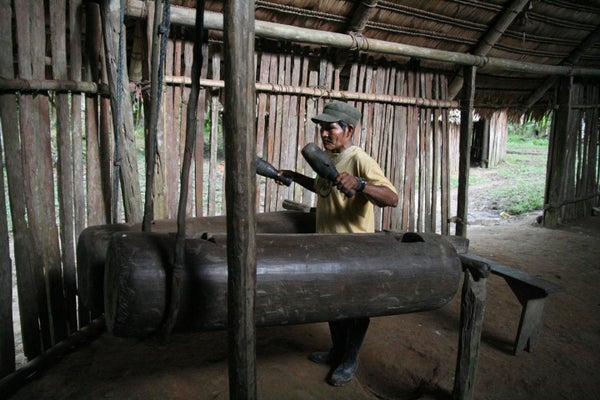

Before the internet or cell phones, radio or telegraph, long-distance communication meant riders on horseback, carrier pigeons or semaphore. But various cultures also developed ways to produce audio messages that travel miles—like the sounds of the manguaré drums of the Bora people in the northwestern Amazon.
The drums look like wooden cannons, with a slit on top. A player stands between two of them and beats out a rhythm—either purely musical, or a Morse code–like message. For example:
"Bring the coca leaves for toasting." <
On supporting science journalism
If you're enjoying this article, consider supporting our award-winning journalism by subscribing. By purchasing a subscription you are helping to ensure the future of impactful stories about the discoveries and ideas shaping our world today.
"They have this fantastic sound which resounds through the jungle and can be heard up to 15 to 20 kilometers away." Frank Seifert, a linguist at the University of Amsterdam and the University of Cologne. "That extends the range of the human voice by about a hundred."
There's a drinking game in Bora culture: who can drink the most cahuana, a non-alcoholic cassava drink. The winner might declare, <
Seifert and his team analyzed those beats and the corresponding spoken phrases, <
"Depending whether the vowel is long or short, and whether there's consonants intervening between the vowels, the pauses between the beats are going to be shorter or longer."
The findings are in the journal Royal Society Open Science. [Frank Seifart et al., Reducing language to rhythm: Amazonian Bora drummed language exploits speech rhythm for long-distance communication]
Seifert says studies of Bora drumming may ultimately reveal something more fundamental about spoken language. "I think that shows very clearly how this fine temporal structure of language, this rhythmic structure embedded in speech, how important that is for language processing in general."
In the early 1900s, manguaré drums were reportedly heard daily in this part of the Amazon. Today, only 20 drums remain, and the Bora language is losing turf to Spanish. But for now…the beat goes on.
—Christopher Intagliata
[The above text is a transcript of this podcast.]
