

[Sound of bat echolocation]
"What you're listening to is what I like to call the beautiful chaos of the bat echolocation stream." Laura Kloepper, a bioacoustician at Saint Mary's College in Indiana. "So you're listening to the sound of probably a couple hundred bats emerging per second from the cave and there's a microphone that we have suspended in the middle of the bats to record the sounds. These are the echolocation sounds the bats make when they're flying and this is what they use to help navigate and find prey."
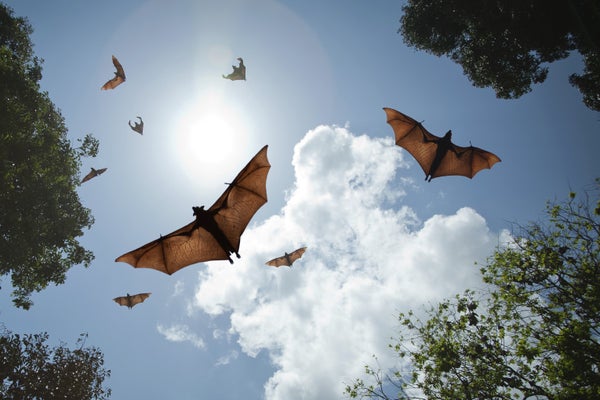
The sounds—slowed down 10 times so we can hear them—were recorded at a network of lava tube caves in New Mexico. Kloepper and her colleagues camped out there to study how Mexican free-tailed bats echolocate in huge swarms without jamming each other's signals. And they noticed that the intensity of the “bleeps” seemed to correlate with the number of bats fluttering out of the cave. Meaning, maybe you could survey their populations with audio. "One night we were sitting around the campfire at our field site and we said, I wonder if this would actually work?"
On supporting science journalism
If you're enjoying this article, consider supporting our award-winning journalism by subscribing. By purchasing a subscription you are helping to ensure the future of impactful stories about the discoveries and ideas shaping our world today.
So they set up a new experiment, capturing audio and GoPro video at the cave site. They counted the bats in each video frame, and correlated that to the zips and zaps <
"Historically what has been used to estimate bats has been photographic estimates, visual estimates, mark-recapture estimates, and those have been highly prone to bias." Newer technology, like thermal imaging cameras is accurate, but expensive. So at a time of epic bat mortality—due to, for example, the fungal white nose syndrome that’s wiping out bats in Canada and the U.S.—Kloepper says her method might be a cheap, reliable way to determine the most critical caves to save.
—Christopher Intagliata
[The above text is a transcript of this podcast.]
