

Rachel Feltman: Happy Monday, listeners. For Scientific American’s Science Quickly, I’m Rachel Feltman. You’re listening to our weekly science news roundup.
First, let’s check in on the hantavirus situation. Tanya Lewis, SciAm’s senior desk editor for health and medicine, is here with an update.
Feltman: Tanya, thanks so much for coming on to chat with us.
On supporting science journalism
If you're enjoying this article, consider supporting our award-winning journalism by subscribing. By purchasing a subscription you are helping to ensure the future of impactful stories about the discoveries and ideas shaping our world today.
Tanya Lewis: Yeah, thanks so much for having me.
Feltman: So how have things changed with regard to hantavirus since we last spoke?
Lewis: More people have been confirmed to have the virus or are suspected to have it. We’re now up to 11 suspected cases and three deaths, two of which were confirmed cases, I believe.
While there are more cases the virus has not spread, you know, wildly, and these are all cases that were passengers on the ship itself, so we have yet to see sort of secondary cases. So it’s somewhat reassuring. But we still don’t completely understand all the ways that it transmits.
This virus could still transmit through the air. We’re not talking about, you know, COVID-like virus that is very, very transmissible, but the hantavirus Andes variant has been known in the past to spread among people in close contact but also in situations like a party, where there was, you know, people just talking to each other in an enclosed space.
But the general public probably isn’t going to encounter it anytime soon, hopefully. It’s more of a concern for people who had contact with individuals who were on that ship.
Feltman: And speaking of that sort of contact tracing, what do we know about what various government entities are doing to make sure that everyone who did have potential contact is aware, and what kind of advice are those people getting?
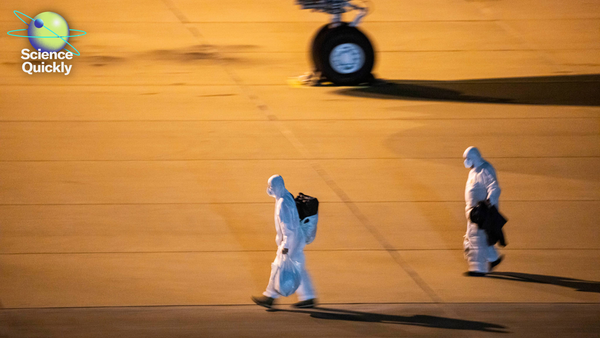
Lewis: So here in the U.S. there are, I believe it’s 15 or 16 people who are quarantining in a facility in Nebraska. This is actually the only facility of its kind in the country. It’s a special facility because the rooms are sort of outfitted with HEPA filters and they are what’s called negative air pressure rooms. So if there’s a leak of any kind, it’ll come into the room rather than out.
And that’s just a precaution because if any of these passengers do show symptoms, then they could quickly be contained and moved to the biocontainment unit, which is more like a hospital setting.
And then most countries that have had passengers from this cruise ship return are taking it quite seriously.
Feltman: So what do the next few weeks look like?
Lewis: So I think we’re going to probably just be continuing to monitor these passengers. We may still see more positive cases because hantavirus has a very long incubation period. I think it can be up to as many as 42 days. It’s too soon to say that, like, we’ve seen the last of the cases, but I think it’s at least encouraging that we’ve seen limited spread.
Feltman: Thanks, Tanya! Listeners, remember to check ScientificAmerican.com for more up-to-date news.
Our next story features a health condition that many of you are likely familiar with, but it has a snazzy new name. The artist formerly known as polycystic ovary syndrome, or PCOS for short, will now go by polyendocrine metabolic ovarian syndrome, or PMOS.
That change comes courtesy of a policy paper published last Tuesday in the Lancet in which a global science consortium broke down the inaccuracy of the historically used term. The new name is based on thousands of patient surveys and the input of 56 medical and patient societies.
PCOS has actually always been a kind of misnomer for this condition, which the World Health Organization estimates affects up to 13 percent of women worldwide. The “cysts” referred to in the original name are actually follicles that would normally mature and release eggs but instead sit in arrested development. They’re entirely different from the types of ovarian cysts that can cause pain or even rupture and sometimes require surgery.
But beyond that semantic cyst confusion, there’s the fact that many people who have been diagnosed with PCOS in the past due to their levels of the hormone androgen and irregular periods, which are also hallmarks of the condition, don’t even have the follicular “cysts” in question.
That likely contributes to underdiagnosis. The WHO estimates that up to 70 percent of women with the condition don’t know that they have it. And that’s a potential problem even if you don’t experience severe symptoms from PCOS itself because PCOS, or now PMOS, is associated with a higher risk of several other conditions, such as hypertension, gestational diabetes and endometrial cancer. In fact, research increasingly suggests that this condition isn’t just about the ovaries; it’s also about the metabolic system.
That leads us to another reason why this name change is so important. Studies have found that the male relatives of women diagnosed with PCOS/PMOS have an increased risk of some of the same metabolic and hormonal issues. While the name change may not explicitly help men, it’s a step toward recognizing that the condition often affects more than just reproductive health and that it could also affect people without ovaries.
Last week’s paper publication is just step one of an eight-stage plan the consortium has for cementing the change from PCOS to PMOS. The change could officially enter the International Classification of Diseases when it’s next updated in 2028.
Now let’s check in with SciAm’s chief newsletter editor, Andrea Gawrylewski. She’s here to tell us about a surprising real-world application of subatomic particle detection.
Andrea Gawrylewski: Thanks, Rachel.
Fun fact: subatomic particles are passing through us right now. And one variety is called muons.
When supernovas explode they shoot out cosmic rays into the universe. Eventually, those cosmic rays collide with Earth’s atmosphere and produce muons. Muons are raining down constantly, traveling at nearly the speed of light, and they can penetrate 1.5 kilometers into Earth’s surface.
A group of geophysicists working with other experts at Canada’s national-particle physics laboratory devised a device that can measure muons outside of the lab. You might be asking: Why would it be useful to detect muons outside of a lab? Well, scientists have used muon detectors for decades to visualize inside the great pyramids of Giza, volcanoes and some tunnels. But those devices were massive—like the size of a room. So some of those Canadian scientists developed a much smaller device that can be placed out in the wild to detect muons.
One big application will be in mining. Minerals like copper, gold, silver and palladium are absolutely crucial for developing technologies like cell phones, data centers, medical devices and satellites. But the need for these minerals far outpaces availability, so the mining industry is looking for ways to improve how they find ore and how well they can extract it.
That’s where a muon detector would come in handy. Each muon carries information about its direction of travel and the density of the material it has passed through. So placing detectors underground and measuring the arriving muons makes it possible to create a high-resolution, cone-shaped, three-dimensional map of the surrounding rock.
This could help mining companies create models of existing mining sites to ensure all resources have been extracted. Visualizations like this could also help them avoid subsurface air pockets, which can cause cave collapses and dangerous back drafts.
All in all it’s a pretty nifty use of measuring subatomic particles.
If you’d like to hear more fascinating stories like these, sign up for my free daily newsletter, Today in Science, at SciAm.com/#newsletter.
Back to you, Rachel.
Feltman: Thanks, Andrea! Listeners, don’t forget to check out Today in Science if you want all the best of Scientific American right in your inbox. You’ll find info about subscribing in our show notes.
All right, you know I can’t resist ending with a fun animal story. And this one gets to the bottom of some very unusual animal behavior.
A study published last Monday in the journal Ecology and Evolution describes a fascinating example of animal symbiosis. Scientists noticed some unusually cheeky behavior from remoras. These are fish with a tendency to suction themselves onto sharks and other animals, as well as boats and sometimes even human divers. But I guess we should be thankful that we don’t have the same kind of relationship that they do with manta rays because according to this study, remoras sometimes engage in a practice the researchers dubbed “cloacal diving.”
Now, if you’re not familiar with the cloaca, in many animals this is a sort of all-purpose chute for inputs and outputs below the belt, everything from mating to excreting to laying eggs or giving birth. Apparently when some remoras interact with manta rays, instead of just clinging to the ray’s skin, remoras burrow themselves into the larger animal’s cloaca. Now, for the fish this can make for a cozy spot to hide from predators, allow them to hitch a ride without feeling the drag of the water and give them first dibs on a manta ray’s bodily waste for dinner, which is something they like. According to the study, the manta rays are less enthusiastic about the practice.
That’s all for this week’s science news roundup. We’ll be back on Wednesday with a deep dive on NASA’s ambitious plans for a nuclear reactor on the moon.
Science Quickly is produced by me, Rachel Feltman, along with Fonda Mwangi, Sushmita Pathak and Jeff DelViscio. This episode was edited by Alex Sugiura. Shayna Posses and Aaron Shattuck fact-check our show. Our theme music was composed by Dominic Smith. Subscribe to Scientific American for more up-to-date and in-depth science news.
For Scientific American, this is Rachel Feltman. Have a great week!
