
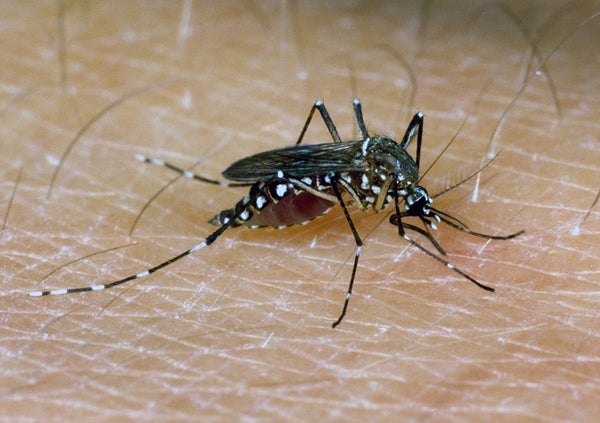

Believe it or not, mosquitoes don’t bite out of spite. Female mosquitoes of the species Aedes aegypti need the nutrients present in your plasma to ensure the proper development of their eggs. And though their thirst may seem unquenchable, the ladies actually take time to savor your blood once they’ve sipped their fill.
“After a female bites, she’ll double her body weight, and then she’ll actually completely lose interest in biting people for several days.”
Laura Duvall, a postdoctoral researcher at The Rockefeller University in New York City. The insects’ postprandial recovery phase made Duvall and her colleagues wonder whether they could essentially trick mosquitoes into thinking they’d already eaten.
On supporting science journalism
If you're enjoying this article, consider supporting our award-winning journalism by subscribing. By purchasing a subscription you are helping to ensure the future of impactful stories about the discoveries and ideas shaping our world today.
Duvall works in the lab of Leslie Vosshall, who studies genetics, neuroscience and behavior. Here’s Vosshall:
“Our idea was that maybe the same drugs that would turn off human appetite might actually work to turn off mosquito appetite.”
Turns out that when the Rockefeller researchers fed mosquitoes a drug used to treat people for obesity, the insects were indeed less interested in hunting for their next human meal ticket.
“But the problem was we needed to figure out how the human diet drugs were actually working in the mosquito.”
So they isolated the receptor protein with which these diet drugs interact. The receptor…which they dubbed NPYLR7…looks a lot like the receptors that regulate hunger in people.
The researchers knew they had the right receptor because, when they knocked it out in some mosquitos, the drugs no longer dampened the insects’ appetite…a finding they describe in the journal Cell. [Laura B. Duvall et al., Small-Molecule Agonists of Ae. Aegypti Neuropeptide Y Receptor Block Mosquito Biting]
In fact, the mutant mosquitoes were all-around insatiable.
“So the npylr7 mutants behave really strangely. Even after they take a huge blood meal, they remain thirsty for human blood.
Next, Duvall says they’d like to explore exactly how these drugs act to curb a female’s blood lust.
“Does she become less sensitive to the clues that tell her a human is nearby? Or is this like smelling a hamburger after you’ve already eaten three?”
Either way, the approach could provide a novel method to limit the spread of diseases transmitted by mosquito bite, like dengue and yellow fever. And give us a new way to tell mosquitoes to buzz off.
—Karen Hopkin
[The above text is a transcript of this podcast.]

