
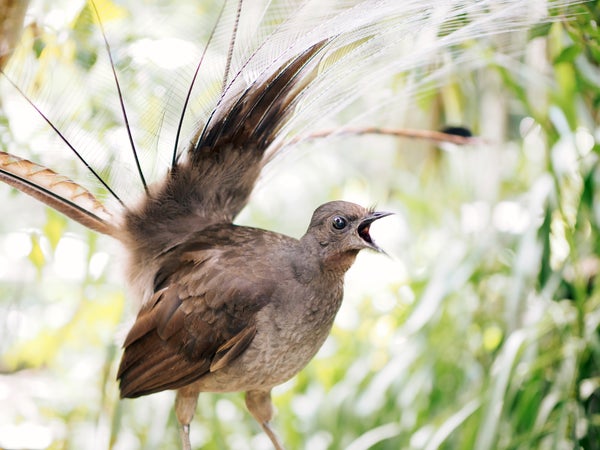

The melodious sounds of trills and tweets, whistles and warbles are a harbinger of spring. But do you ever wonder what birds are actually talking about? Maybe they’re catching up after a winter away. Or maybe they’re saying, “Step off, this twig is my territory.” Or maybe they’re signaling that there’s a predator about—even when there isn’t.
Well, if a bird crying wolf sounds silly, a new study shows that in Australia, certain male songbirds use this trick to get females they wish to woo to stick around a little longer. The results appear in the journal Current Biology. [Anastasia H. Dalziell et al., Male lyrebirds create a complex acoustic illusion of a mobbing flock during courtship and copulation]
The superb lyrebird, spelled l-y-r-e, is famous for its ability to imitate sounds in its local environment. From the fluid melody of a shrike thrush ...
On supporting science journalism
If you're enjoying this article, consider supporting our award-winning journalism by subscribing. By purchasing a subscription you are helping to ensure the future of impactful stories about the discoveries and ideas shaping our world today.
[CLIP: Shrike thrush sound]
... to the distinctive laugh of a laughing kookaburra.
[CLIP: Kookaburra sound]
The males weave these aural entertainments into songs they sing to attract mates.
Anastasia Dalziell: They sing from the tops of the trees before dawn throughout the day—and even into dusk during the breeding season. And this recital song, most of it is mimicry. The male just reels through imitations of lots of species of forest birds. And they just cycle through them. Each new imitation is different from the rest.
Karen Hopkin: Anastasia Dalziell, a postdoctoral fellow at the University of Wollongong. She and her colleagues were planning on studying this impressive acoustical exhibition.
Dalziell: But we soon realized that, every now and then, the male lyre bird was producing a completely different kind of mimicry.
Hopkin: This alternate routine is trotted out at the very end of the male’s elaborate song-and-dance display. It’s sort of buzzy—even somewhat annoying—and it perfectly reproduces the alarm calls made by a mobbing flock of birds that has spotted a predator.
Dalziell: They’re visually conspicuous. They’re acoustically conspicuous. And they are a very reliable cue of the presence of a predator in the environment.
Hopkin: Even for humans.
Dalziell: I use them, mobbing flocks, to try and avoid stepping on snakes while I’m dong my fieldwork in Australia.
Hopkin: And a single male lyrebird can reproduce the whole shebang.
Dalziell: It’s really impressive. The males even manage to imitate the sounds of small birds—the wingbeats of small birds as they fly over or at the predator. It’s very very convincing.
Hopkin: And what do they hope to achieve with this performance? The clue, Dalziell says, came from determining when they choose to do it.
Dalziell: So we found that males didn’t produce this mobbing flock mimicry when a real predator was around—not at all. The only context in which they produced it, the mobbing flock mimicry, was during courtship and particularly at key moments.
Hopkin: The first is when the male has sung his little heart out, entertaining a female with his elaborate and lyrical ballad, but his potential paramour turns up her nose.
Dalziell: And it’s the moment she steps off his display platform, his sort of round circular spot on the forest floor where he does all his song and dances. The moment she attempts to leave, steps off that dancing platform, is when the male switches to his mobbing flock mimicry.
Hopkin: A sound that suggests there’s a predator nearby—when really there isn’t.
Dalziell: So we think this might be a way of the males saying, “Baby, it’s dangerous outside. Stay here safe with me.” And then giving him more opportunity to display his beautiful song-and-dance prowess.
Hopkin: The only other time Dalziell and her colleagues witnessed males pulling this stunt was when they were in the midst of mating.
Dalziell: So the whole thing was absolutely bizarre.
Hopkin: Strange, it’s true. But the researchers speculate that amorous males might give their partners the impression that they’re surrounded by peril ...
Dalziell: ... in order to prevent the females from prematurely ending the sexual interaction—prematurely, that is, from the point of view of the male.
Hopkin: Because if the male doesn’t deliver what he promised, the female might decide to take an early flight.
