

Rachel Feltman: Happy Monday, listeners, and of course, May the 4th be with you. For Scientific American’s Science Quickly, I’m Rachel Feltman. You’re listening to our weekly science news roundup.
Let’s start with some health news. If you or your partner has ever been pregnant, you may have heard of preeclampsia. It is a life-threatening condition that arises in as many as one out of 12 pregnancies in the U.S. Marked by high blood pressure and protein in the urine, the condition can lead to serious complications like organ damage in the pregnant person and a diminished blood supply to the fetus. There’s currently no cure other than delivery, which is why preeclampsia causes about 15 percent of all premature births in the U.S.
Because of the risks faced by preterm infants, doctors often have to play a waiting game where they monitor a parent’s symptoms to delay inducing labor or performing a C-section as long as possible. The longer they wait, the longer the pregnant person remains in danger.
On supporting science journalism
If you're enjoying this article, consider supporting our award-winning journalism by subscribing. By purchasing a subscription you are helping to ensure the future of impactful stories about the discoveries and ideas shaping our world today.
Last week researchers published a small, preliminary study in Nature Medicine outlining a potential treatment for patients stuck in this limbo. The pilot trial, which featured 16 women with preterm preeclampsia, filtered a troublesome protein out of patients’ blood.
The treatment targets a protein called sFlt-1, which previous research has identified as a key driver of the blood vessel constriction that can make preeclampsia so dangerous. Using a blood-filtering device, researchers removed sFIt-1 from their subjects and then returned the cleaned blood to their bodies. The procedure seemed to stabilize their blood pressures and extended their pregnancies by an average of 10 days—that’s twice what the researchers would have expected for an untreated group. Five days might not sound like an impressive achievement if you’ve never had to play this dangerous waiting game yourself, but it can make a huge difference. When it comes to preterm birth—birth before 37 weeks of gestation—research shows that even an extra day or two in the womb can drastically improve a baby’s outcomes. The next step is a much larger, randomized control trial to help us understand how effective the treatment really is and how best to implement it.
Last week, genome sequencing pioneer and scientific iconoclast J. Craig Venter died. As we wrote last week, "Venter rose to fame in the field for publishing the first bacterial genome ever decoded, along with a list of gene annotations, in 1995. The achievement kicked off an age of discovery in genetics, with researchers racing to decode the genomes of other pathogens—and eventually animals." He had a conversation with SciAm's executive editor Jeanna Bryner just one month before his passing. Here he is in his own voice sharing his clear-eyed thoughts about science, death, and legacy.
J. Craig Venter: You have to take risks. If you're risk adverse, you're in the wrong field. It's the definition of doing experiment. My favorite job is being an experimentalist, you know. I can ask questions and you try and get answers. Sometimes you get a different answer than you want. Being a fundamental experimentalist is the essence to me of science. I think I've been very lucky in my career in having the ability to try and answer big questions. I always tell people, if you want immortality, do something meaningful while you're alive.
Feltman: Now for some news from the clean energy sector. Last Monday the Trump administration announced that it would pay two energy companies to abandon the U.S. offshore wind projects they’ve been developing. Bluepoint Wind and Golden State Wind, which were slated to sit off the coasts of New York–New Jersey and California, respectively, could have each produced enough energy to power more than one million homes. Instead, the Department of the Interior will refund the companies behind these projects a total of about $885 million in lease fees—on the condition that they reinvest that money in fossil fuel projects. And just to be clear, that money is coming from American taxpayers.
The administration has already made at least one other similar buyout deal after failing to halt various offshore wind projects on legal grounds. In trying to halt offshore wind projects, the administration cited a 2024 Energy Department report on how turbines can cause radar “clutter” and confuse these systems which they argued would be a national security risk. But that same report actually offered several techniques for mitigating any of those risks.
You may have also heard the president cite concerns about wind turbines harming whales and birds. While some birds do unfortunately die flying into wind turbines each year, the estimates pale in comparison to the number killed flying into power lines or even slain by house cats. And a 2025 report by the Government Accountability Office found risks to whales to be minimal. Meanwhile, air pollution from fossil fuels kills an estimated 91,000 people each year in the U.S. alone, according to a study published in 2025. And going back to the radar question, when it comes to national defense, you don’t have to look too hard to see some very real downsides to our continued reliance on fossil fuels. I’ll make it even easier for you: you just want to zoom right in on the Strait of Hormuz.
Speaking of defense, we’ve got another news story from SciAm’s chief newsletter editor, Andrea Gawrylewski.
Andrea Gawrylewski: Thanks, Rachel.
In global geopolitics sometimes rumors emerge that this country can crack any encrypted code or that country has developed a new kind of high-tech weapon. And if the U.S. were to take seriously any claim like that, they might end up spending time and resources trying to combat it, or create their own version of it or some defensive tactic, without really knowing if that country actually can make that kind of technology.
So to be able to do a sort-of fact check of big tech claims like this, the military’s premier research arm, the Defense Advanced Research Projects Agency, or DARPA, launched a new program called SciFy, which is short for Scientific Feasibility. And that’s exactly the purpose: to determine how feasible any wild technology claim might be. In essence, it’s the military’s BS detector. And DARPA built its own AI to be one of the central tools in this program.
So how might this work? In a really bare-bones example, let’s say some unnamed rival country claims that it made military armor out of a material that can repair itself. The SciFy AI might do the following fact-check: In order for a self-healing material to exist, it would need to be solid in a frigid tundra and solid in a steamy jungle with much higher temperatures. But maybe all the research literature up to this point or a simulation of that material’s properties shows it would actually melt to liquid in tropical weather. Obviously, liquid armor doesn’t work, so SciFy would determine this bold claim is total BS.
But this technology could also be used in the future to determine if cool projects here in the U.S. are worth investing in.
If you’d like to keep up to date with cool stories like these, sign up for my free daily newsletter, Today in Science. Back to you, Rachel.
Feltman: Thanks, Andrea!
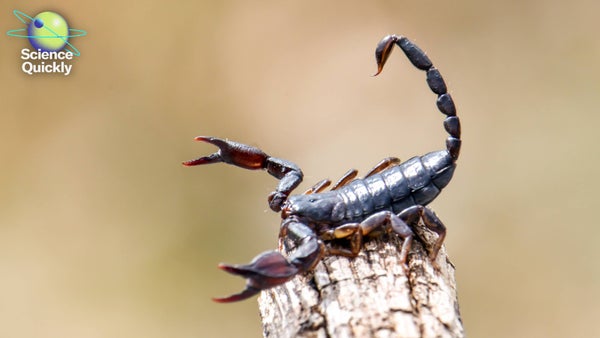
Let’s wrap up today’s show with a couple of fun ones. First, you probably already think of scorpions as being pretty metal, in the hardcore sense of the word. But did you know that they’re also actually literally metal.
Scientists already knew that certain arachnids, like some spiders and scorpions, along with some other arthropods, such as ants, use traces of metal to strengthen parts of their exoskeletons—though, honestly, this is big news to me. In a study published last Wednesday in Journal of the Royal Society Interface, researchers show that the distribution of those metallic elements likely has something to do with how different species of scorpions hunt.
Using museum-collection specimens from the Smithsonian, the scientists analyzed 18 different species to understand how scorpions use metals like zinc, manganese and iron in their exoskeletons, which are otherwise made of a natural polymer called chitin that you’d find in, like, any old beetle shell. The researchers found that metal appeared in very specific locations—think the tippy top of a stinger instead of the whole tail—and zinc, in particular, could show up in both claws and stingers but seems to only feature heavily in either one or the other in any given species. That could have to do with which of those weapons the scorpion use preferentially when they hunt, which isn’t the same for all species.
Our last story poses—and answers—a question you probably haven’t thought to ask before: Where was your backyard 320 million years ago? Like, where was it?
Okay, so, remember learning about Pangaea back in school? It was Earth’s most recent supercontinent, which is what you get when our planet’s tectonic plates drift together and most of the landmasses slowly smoosh into one.
Starting a bit over 300 million years ago and for around 100 million or so years after that, if you wanted to be on land, Pangaea was the only game in town. Last week an international team of earth scientists published the latest version of a tool that lets you turn back the geological clock for any location on the planet. In other words, you can watch how your neighborhood drifted through geological time, all the way from Pangaea days to its modern location. You can try it out for yourself at Paleolaltitude.org.
So, how did they do this? Over millions of years moving tectonic plates crumple rock into mountain ranges. The scientists basically worked backwards to “unfold” those crumpled rocks and figure out where all the plates originally were relative to one another. But knowing how plates moved relative to one another isn’t enough—you also need to know where on the globe they were (especially their latitude, i.e., how far north or south). Luckily, rocks can kind of act like compasses sometimes. When many rocks form, magnetic minerals inside them lock in the direction of Earth’s magnetic field at that exact moment. Since the magnetic field points at different angles depending on your latitude, you can read those minerals to work out where on Earth the rock was formed.
The tool has some fascinating potential for research applications, such as helping paleontologists confirm the latitude where their fossil specimens were located back when they were a little more lively. But let’s be real: you just want to use it to see where your house would have been when it was a literal Jurassic park—which by the way means going back about 150 million years.
[CLIP: Brief snippet of the Jurassic Park theme music]
Feltman: That’s all for this week’s science news roundup. We’ll be back on Wednesday to see what really happens when robots try to take our jobs.
Science Quickly is produced by me, Rachel Feltman, along with Fonda Mwangi, Sushmita Pathak and Jeff DelViscio. This episode was edited by Alex Sugiura. Shayna Posses and Aaron Shattuck fact-check our show. Our theme music was composed by Dominic Smith. Subscribe to Scientific American for more up-to-date and in-depth science news.
For Scientific American, this is Rachel Feltman. Have a great week!
