
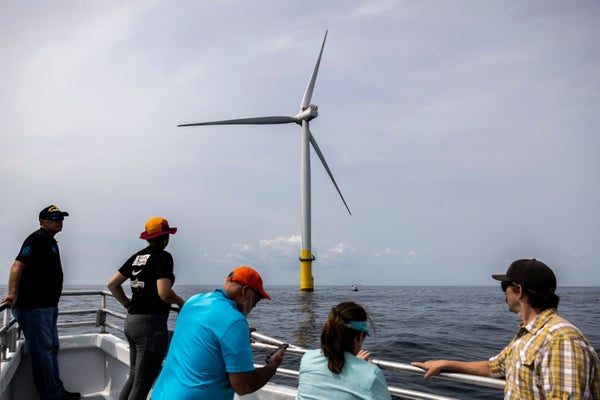
The Trump administration on Monday announced it was “pausing—effective immediately” leases for five large offshore wind farms being built off the East Coast. In the announcement, Department of the Interior secretary Doug Burgum cited “emerging national security risks” for the decision, but the agency provided no evidence as to what risks had been found.
The five projects affected by the pause are offshore of New York State, Connecticut, Rhode Island, Massachusetts and Virginia. Around 5.8 gigawatts of offshore wind was expected to come online in the U.S. between 2025 to 2029—enough to power millions of homes across the Eastern Seaboard. Some $10 billion has been invested in the U.S. wind industry since 2021. The Trump administration decision imperils both that investment and future energy capacity.
A statement announcing the decision on Monday indicated that wind turbines caused radar “clutter,” referencing a 2024 Energy Department report that looked into wind turbines’ effect on radar systems.
On supporting science journalism
If you're enjoying this article, consider supporting our award-winning journalism by subscribing. By purchasing a subscription you are helping to ensure the future of impactful stories about the discoveries and ideas shaping our world today.
That report warned that clutter from wind turbines in the line of sight of defense and civilian radar systems can cause interference and lead to false alarms. One strategy to mitigate this problem, the report noted, is to lower radar detection thresholds—which reduces the clutter but could result in missing “actual targets.” Another option the report proposed is to ensure wind farms aren’t built in a radar’s line of sight.
"We should not be kneecapping America’s largest source of renewable power, especially when we need more cheap, homegrown electricity," said Ted Kelly of U.S. Clean Energy at the Environmental Defense Fund, in a statement. "Instead, this administration has baselessly and unlawfully attacked wind energy," he added.
One of the affected projects, the Coastal Virginia Offshore Wind project, was sited “in close coordination with the military,” according to a spokesperson for Dominion Energy, which operates the wind farm, in comments to the New York Times. Indeed, wind farm operators, scientists and the military have collaborated on minimizing radar effects of wind farms for decades. Burgum on Monday told Fox Business that the decision to pause the projects came because the Department of Defense “has come back conclusively that ... these large offshore wind programs create radar interference.”
The Department of the Interior and the Department of Defense did not respond to a request for comment.