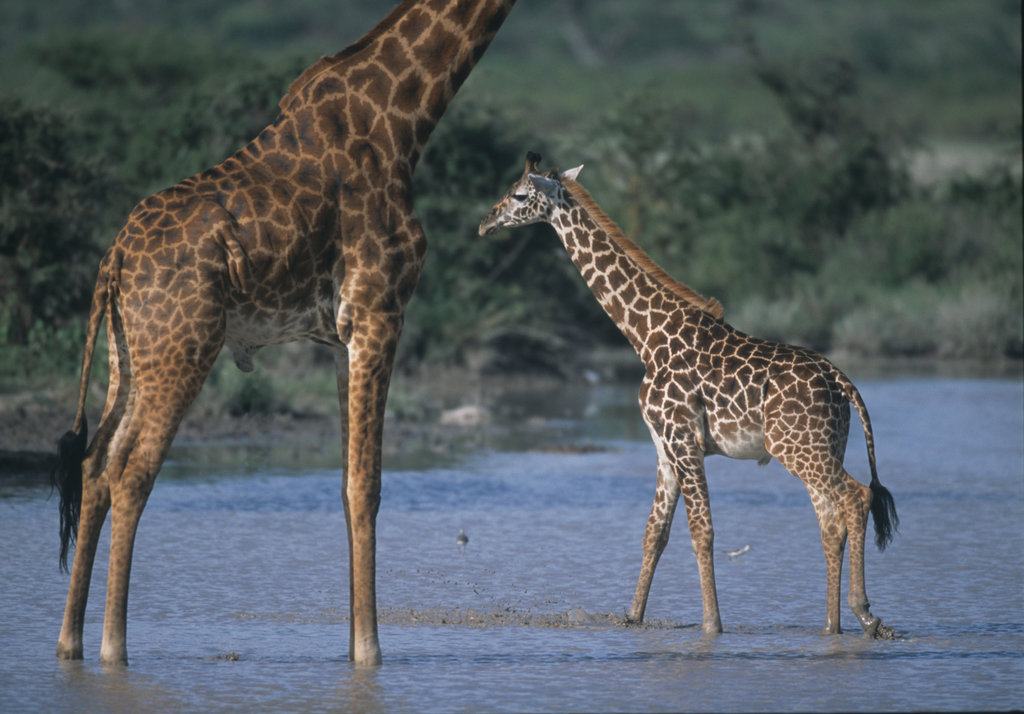

Just like humans have virtually unique sets of fingerprints, every giraffe has a unique set of spots. Not that those spot patterns really help wildlife biologists identify their study subjects in real time.
"We have more than 3,000 individuals. … I have a hard time keeping track of that many humans so I have that problem with giraffes as well."
Derek Lee is a wildlife biologist and population ecologist at Penn State, and with the Wild Nature Institute, a research consultancy group. He and his collaborators have been tracking giraffes for seven years, throughout 1,500 square miles in Tanzania. And they've amassed a library of 70,000 giraffe photos along the way. Photographing the animals isn't that hard, he says.
On supporting science journalism
If you're enjoying this article, consider supporting our award-winning journalism by subscribing. By purchasing a subscription you are helping to ensure the future of impactful stories about the discoveries and ideas shaping our world today.
"The hard part is the tsetse flies constantly biting us on our face and hands while we're trying to take pictures."
Now, they've used image analysis software to study the spots of mothers and their calves. And they found that baby giraffes inherit at least some particular elements of their patterning from their mothers. Like how circular the spots are, and how jagged the edges are.
They also found that calves with larger spots were more likely to survive their first months on the savannah, perhaps because the spots better mimic the dappled sunlight in the bushes where calves like to hide from hungry lions and hyenas.
The results—and a lot of giraffe patterns—are in the journal PeerJ. [Lee et al., Seeing spots: quantifying mother-offspring similarity and assessing fitness consequences of coat pattern traits in a wild population of giraffes (Giraffa camelopardalis)]
It’s perhaps not surprising that a physical characteristic that protects an individual from being eaten passes the test of Darwinian natural selection—and get passed along to offspring. "The fact these things are heritable and they did affect juvenile survival makes us feel like evolution is acting on these spot traits." So if mom's camouflage is good, her babies, too, might have the spots that make them harder to spot.
—Christopher Intagliata
[The above text is a transcript of this podcast.]