
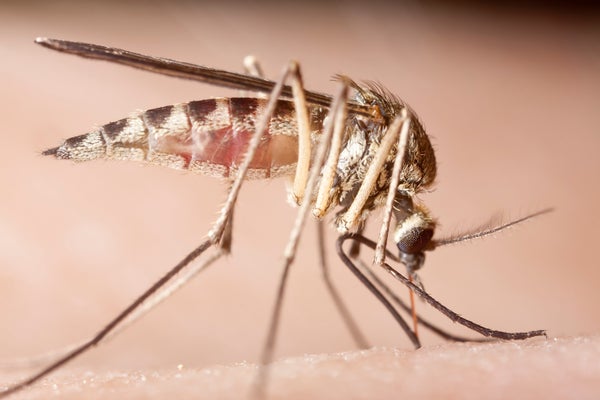

Sucking blood is risky business. At least for the female mosquitoes that need those nutrients to nurture their developing eggs. Not only do these bugs have to find a suitable blood donor, but once they’ve had their fill, they have to be able to escape undetected—to avoid the big swat. How they finesse this stealthy departure has just been revealed in the Journal of Experimental Biology. [F. T. Muijres et al., Escaping blood-fed malaria mosquitoes minimize tactile detection without compromising on take-off speed]
Feasting on an unsuspecting mammal can double a mosquito’s body mass. So how does a fully loaded female heave that added bulk off the skin of her host without triggering its pressure sensors and bringing on that fateful slap? To find out, Florian Muijres of Wageningen University in The Netherlands and his colleagues used cameras that record 13,500 frames per second to capture the takeoff maneuvers of 63 blood-fed malarial mosquitoes.
What they discovered is, when it comes to a soft yet speedy getaway…for female skeeters, the wing’s the thing. With a wingbeat frequency of about 600 beats per second…the insects are able to lift themselves lightly off their host. That approach is the opposite of the one favored by most other winged things, says Muijres.
On supporting science journalism
If you're enjoying this article, consider supporting our award-winning journalism by subscribing. By purchasing a subscription you are helping to ensure the future of impactful stories about the discoveries and ideas shaping our world today.
“Most flying animals when they take off, like birds or a fly for, example, they first use their legs to push off very hard, and then when they are in the air, then they start beating their wings and generate aerodynamic lift to be able to fly away. Mosquito does it the other way around. It first starts beating its wings and through the aerodynamic forces these wings generate, their body is being lifted off from the substrate. And then they also do gently push down with their long legs to be able to further power their liftoff. But these forces that are being generated by the legs are relatively small.”
In fact, the faint flutter of a mosquito’s wings produces less than one third of the force exerted by similar-sized but much less subtle fruit flies as they shove off in search of another banana. And even on a full stomach, these bloodsuckers are stunningly fast, says Muijres. “So takeoff phase takes only about 30 milliseconds, which is 10 times faster than how fast we can blink our eye.” And they’re gone before we know what hit us. And before we can hit them.
—Karen Hopkin
[The above text is a transcript of this podcast.]
