
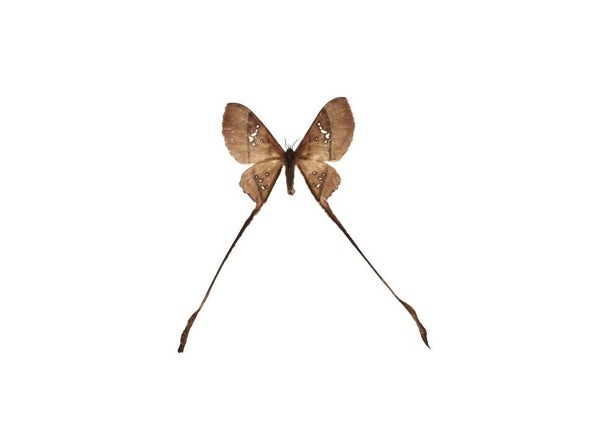

If you've ever watched a moth flutter clumsily around a light on your porch, the insect might seem like a sad match for a predatory bat. The flying mammal is practically a fighter jet in comparison, with its sophisticated sonar and acrobatic maneuvers.
But some moth species have evolved high-tech tricks of their own—for example, their wings have long, dangling tails. "They're fluttering in space and they're twisting behind the moth as the moth flies, creating an alternative echoic target that the bat perceives as a target it can attack." Juliette Rubin, a sensory ecologist at Boise State University.
Rubin and her team investigated that phenomenon by experimentally altering the wings of moths. With some moths they snipped the hind wing lobes and tails. With other moths they glued on extra bits of wing. Then they tethered the differently shaped moths, one at a time, in a padded, darkened chamber…a sort of gladiatorial ring for bats on the hunt…and observed the battle with high speed video and ultrasonic microphones. <
On supporting science journalism
If you're enjoying this article, consider supporting our award-winning journalism by subscribing. By purchasing a subscription you are helping to ensure the future of impactful stories about the discoveries and ideas shaping our world today.
Turns out, it was the moths with longer hind wings or wing tails that lived to fly another day… because the bats often wound up with just a mouthful of tail.
"And of course these tail ends do not have a nutritional value and would not be a wise place for the bat to attack if it really wanted to capture the moth. So it seems these tail ends are attracting bat attack--we don't yet quite know the mechanism but they seem to be creating an illusion for the bat that that is another place it can attack and successfully complete its hunting behavior."
The details are in the journal Science Advances. [Juliette J. Rubin et al., The evolution of anti-bat sensory illusions in moths]
The researchers write that this decoy strategy has independently evolved multiple times, among different families of moths. Which suggests that this sensory illusion is a powerful tool, in the ongoing evolutionary arms race between the hunter and the hunted.
—Christopher Intagliata
[The above text is a transcript of this podcast.]
