
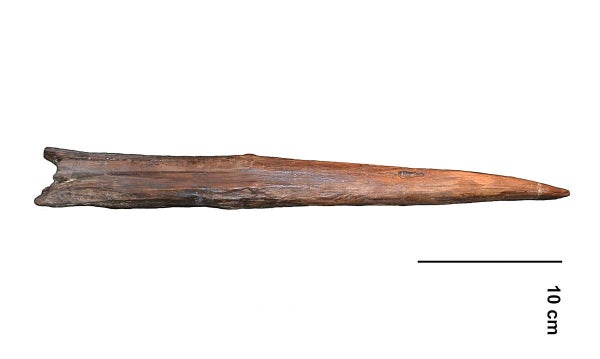

The time: 300,000 years ago. The scene: a herd of horses, struggling in mud. A short five meters away, a group of early Neandertal hunters, throwing a volley of wooden spears towards the animals. "And then probably coming in to an injured horse and then perhaps finishing it off with a thrusting spear.” Annamieke Milks, a paleolithic archaeologist at University College London.
But there's something not quite right about that classic scene, she says. Specifically: the Neandertal's spears may have been more sophisticated—and more lethal—than we've given them credit for. Which would alter that ancient tableau.
"We believe that Neandertals could have thrown them from farther away; that would have allowed them to approach animals that weren't disadvantaged. And that they wouldn't necessarily have needed to come right up close to the animal and kill it with a thrust. Some of these shots with the throwing spear could be lethal to an animal if they hit in the right way."
On supporting science journalism
If you're enjoying this article, consider supporting our award-winning journalism by subscribing. By purchasing a subscription you are helping to ensure the future of impactful stories about the discoveries and ideas shaping our world today.
This revised assessment of Neandertal weaponry began with the crafting of spruce timber into replicas of an actual 300,000-year-old spear. The surface was finished with the same kinds of stone tools used to make the original.
Milks then recruited six male javelin throwers to chuck the replicas at a hay bale. At five meters, they struck the target more than half the time. At 10 to 15 meters, a quarter of the time. But from 20 meters, just one in six throws hit the hay.
"It's still not amazing accuracy, I have to say, I was hoping for better." Though she points out that the javelin throwers aren't trained to hit targets—something Neandertals may have been more skilled at—and the experiment suggests the weapons were at least capable of sailing much farther than had been thought. And high-speed video of the throws proved the spears could strike with deadly force. The research is in the journal Scientific Reports. [Annemieke Milks et al., External ballistics of pleistocene hand-thrown spears: experimental performance data and implications for human evolution]
The crafting of these ancient spears also suggests some degree of intelligence—a concept of, or intuition about, balance, mass and design. For example, whoever crafted these ancient spears used the denser, lower part of the tree trunk for the spear tips, intended to strike prey. But we still don't know which Neandertals used the spears in battle.
"I wanted to emphasize that we chose male athletes, not female athletes, not because we didn't think women were playing a role in hunting, but because we needed a homogenous sample. But I'd be very curious to know how women did in accuracy."
Perhaps another round of tests, with women throwers, can address that…point.
—Christopher Intagliata
[The above text is a transcript of this podcast.]
