
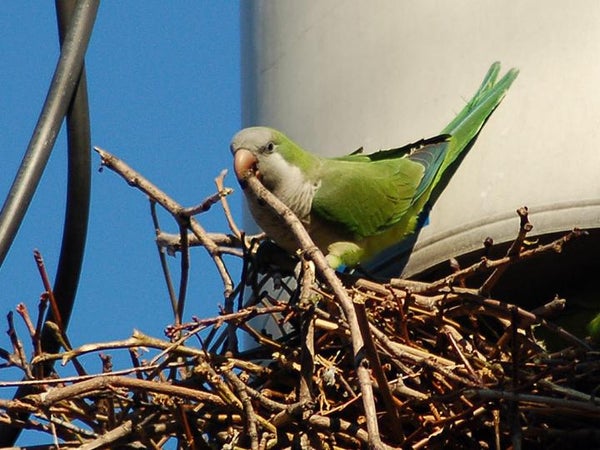

You might expect to hear parrots like these in the wild in South America. But these birds are actually nesting in the middle of Chicago. Despite being known as monk parakeets, the green-and-gray birds are true parrots. And they’ve been living in the Windy City since the 1970s. But not just there.
“There are monk parakeets in many, many states. They’re breeding in around 21 states.”
Jenny Uehling, a Ph.D. student now at Cornell, who was at the University of Chicago when she studied these birds.
On supporting science journalism
If you're enjoying this article, consider supporting our award-winning journalism by subscribing. By purchasing a subscription you are helping to ensure the future of impactful stories about the discoveries and ideas shaping our world today.
“Certain populations will pop up in certain states and then disappear, but they’re by far the most widespread of any of the species.”
Uehling wanted to know how many nonnative parrots were living in the U.S. To do this “we used eBird and Christmas Bird Count, or CBC. We use these two databases because they have the largest spatial distribution of data, basically, for the United States.”
Uehling and her team looked at data collected from 2002 to 2016 and deduced that there were 56 different species of parrots living free in 43 states. Of these species, 25 of them had become naturalized, that is “able to successfully breed and maintain their own population without the addition of additional individuals from captivity.”
Most of these nonnative parrots were either released by owners or escaped from captivity. Some established breeding populations. And some of these new populations are saving entire bird species.
“The red-crowned parrot is declining in its native range, but it’s actually increasing in the U.S., and it’s becoming pretty common. And so I think that leads to a really interesting question of, you know: Could we possibly use these populations of nonnative parrot species to understand the biology of a species declining in its native range?”
The study is in the Journal of Ornithology. [Jennifer J. Uehling, Jason Tallant and Stephen Pruett-Jones, Status of naturalized parrots in the United States]
Florida may have a half-million monk parakeets. And they’re even hardy enough to live year-round in Brooklyn and the Bronx, as well as Chicago. And if you’ve ever heard the racket they make, it’s clear that these monks never took a vow of silence.
—Lucy Huang
[The above text is a transcript of this podcast]
[Monk parakeet sounds courtesy of the Macaulay Library at the Cornell Lab of Ornithology]

