
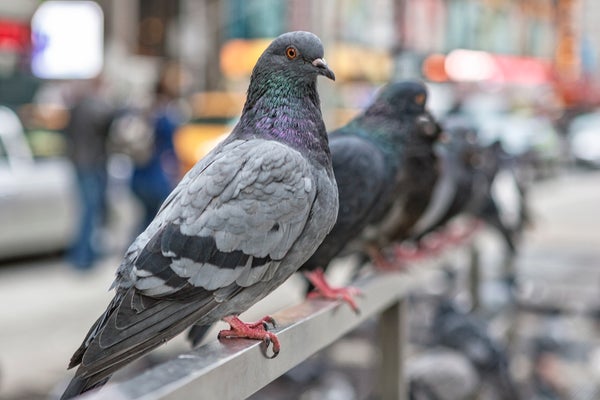

Boston and New York are famed for their rivalries: everything from the Yankees versus the Red Sox to who makes the correct clam chowder. Even the local wildlife has hometown pride—because pigeons that roost near Rockefeller Center are genetically distinct from those that summer at the Cape. The finding is in the journal Evolutionary Applications. [Elizabeth Carlen and Jason Munshi‐South, Widespread genetic connectivity of feral pigeons across the Northeastern megacity]
“I don’t think we could be in a city without thinking about pigeons. And for many people, it’s one of the few daily interactions they have with wildlife.”
Elizabeth Carlen, a graduate student at Fordham University in the Bronx.
On supporting science journalism
If you're enjoying this article, consider supporting our award-winning journalism by subscribing. By purchasing a subscription you are helping to ensure the future of impactful stories about the discoveries and ideas shaping our world today.
As an evolutionary biologist, Carlen was curious about whether pigeons in one city are closely related, genetically speaking, to those from cities nearby. So she did a research-inspired road trip, making stops from Boston to D.C.
“I would drive to a city and start talking to people at Starbucks. Anybody that I could chat with, I would start asking them questions about where they saw pigeons. And I kind of started to gather intel that way.”
Once she’d found a flock, she’d lay down some bird seed ...
“And then use a net gun, which is basically something that looks like a big flashlight. And it shoots a net out over the pigeons.”
With birds literally in hand, she would take a DNA sample.
“I like to call like it a pigeon 23andMe. We’re looking for ancestry and proportion of shared ancestry. And so we can build this big map with all these individuals that kind of tells us who’s more closely related to who.”
Carlen was surprised to find that pigeons in the Northeast can be divided into two distinct populations.
“One population is in Boston and Providence. And then the other population ranges from New York down to Washington, D.C. I had actually, based on previous research, thought that pigeons in each city would form their own separate populations. Because if you have food, and you have mates, why would you go anywhere? Why would you disperse? And what I’m starting to realize is that pigeons actually kind of view this northeastern megacity as one giant city—at least from New York down to Washington, D.C.”
And it wouldn’t take much to promote avian intermixing within this megacity.
“One pigeon will leave New York and go down Philly. And then maybe a pigeon from Baltimore will come up to Philly. And that’s allowing there to be gene flow between all these cities.”
Maybe the feathered foragers are simply following the food. Just think of all the French fries left behind at rest stops along I-95.
“If humans are traveling this corridor quite a bit, it makes sense that pigeons also are traveling it.”
As to why pigeons don’t bother making the trip between Boston and New York, Carlen points to the more manicured lawns of Connecticut.
“Connecticut is a lot more suburban than these other areas, and that might be why pigeons in Providence and Boston are kind of falling out as separate from pigeons in more southern cities.”
Next up, Carlen says she’d like to further explore the relationships that exist within flocks.
“Are they aunts and uncles and cousins and parents and grandparents? Or are they just a random group of individuals that happen to come together?”
Hopefully not in the middle of the road.
—Karen Hopkins
[The above text is a transcript of this podcast.]
