
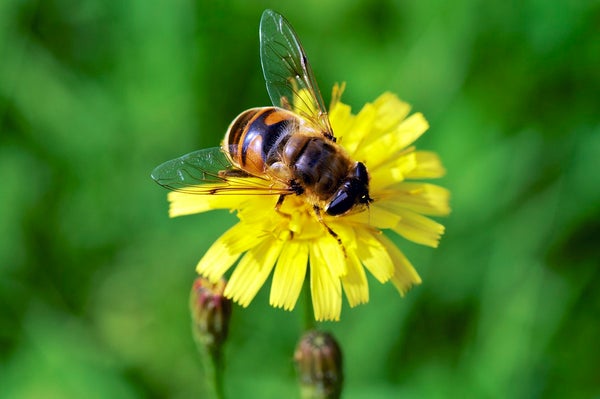

Honeybees are the charismatic microfauna of the pollination world. But flies, bumblebees, butterflies and moths—they all pollinate, too. With varying degrees of success. The poorer ones are technically referred to as 'inefficient pollinators.' "Those that do visit but transfer very little pollen in their visit." Florian Schiestl, an evolutionary biologist at the University of Zurich.
Schiestl and his colleague grew field mustard plants, and exposed them to two types of pollinators: efficient bumblebees and inefficient hoverflies. After just 11 generations, they found that the plants visited by bumblebees were taller, twice as fragrant, and reflected more UV light—a visual signal for bees. And those factors made the progeny even more attractive to bumblebees at the end of the experiment: a sign the plants had adapted to their pollinators' preferences.
But the plants that got a fly-by from the flies? They grew shorter. Less fragrant. And actually adapted to do more self-pollination. Because hoverflies are lousy pollinators. The study is in the journal Nature Communications. [Daniel D. L. Gervasi and Florian P. Schiestl, Real-time divergent evolution in plants driven by pollinators]
On supporting science journalism
If you're enjoying this article, consider supporting our award-winning journalism by subscribing. By purchasing a subscription you are helping to ensure the future of impactful stories about the discoveries and ideas shaping our world today.
So with honeybees in peril, what happens if we lose them? “This will trigger an evolutionary response in the plants. For example, if flies take over as more important pollinators, as they used to be in the past, then very likely we'll have some evolutionary change going on."
And if the change is self-pollination, that could be trouble. "Self-pollination leads to reduction of genetic variability in the population, and this can be a problem for the plants, because they have a reduced ability to evolve resistance against diseases." Meaning that if we lose the pollinators, it’s the plants' genomes that may go to seed.
—Christopher Intagliata
[The above text is a transcript of this podcast.]
