

Karen Hopkin: Dogs and their people.
Christopher Hopkin: Who’s a good boy? Are you a good boy? Yes, you are!
Karen Hopkin: We like to think our pooches can follow what we’re telling them.
On supporting science journalism
If you're enjoying this article, consider supporting our award-winning journalism by subscribing. By purchasing a subscription you are helping to ensure the future of impactful stories about the discoveries and ideas shaping our world today.
Christopher Hopkin: Go get your bally! Over there! Go get it! Good doggy!
Karen Hopkin: Well, to some degree they can—even when they’re young—because a new study shows that puppies are able to track human social cues at just eight weeks of age, before they’ve really spent much time with people. And their ability to do so has strong roots in their genetics. The work appears in the journal Current Biology. [Emily E. Bray et al., Early-emerging and highly heritable sensitivity to human communication in dogs]
Emily Bray: We have known for a long time that adult dogs are especially skilled in understanding cooperative communication from humans.
Karen Hopkin: Emily Bray is a postdoctoral researcher at the University of Arizona and the Canine Companions for Independence.
Bray: So, for example, they can spontaneously follow a human pointing gesture.
Hopkin: They’re even better at it than apes, which are much more closely related to us than canines are, evolutionarily speaking.
Bray: So this begs the question of why.
Hopkin: Is it a skill dogs pick up simply by spending time with people? Or is it a trait that was selected for when dogs first became domesticated?
To find out, Bray and her colleagues logged time with 375 puppies that were going to be trained to be service dogs by Canine Companions. All were either Labradors, golden retrievers or a mix. All were around eight weeks old. And I’m guessing all were pretty adorable.
Bray: You’re such a cute puppy!
[Puppy bark]
Hopkin: Bray figured that by working with pups that had spent the bulk of their young lives with their littermates and mom, she could tease out whether dogs have to learn to interpret human communications—or if it’s something they come by naturally.
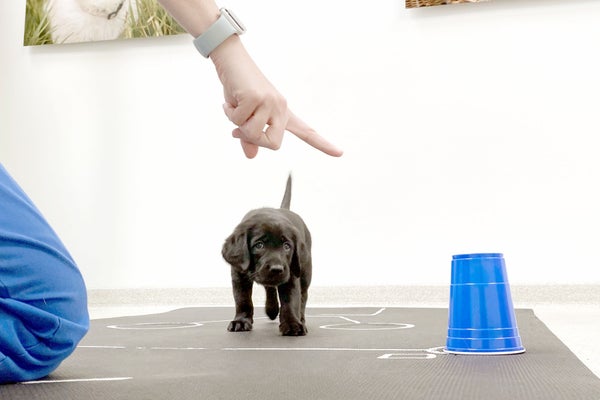
The pups participated in a handful of cognitive tests designed to assess dogs’ social smarts. In one experiment, a researcher would hide food under one of two cups—and then call to the puppy and point toward the cup that held the treat.
Bray: And we found puppies were able to use this social cue effectively, choosing the correct location significantly above what you would expect by mere chance.
Hopkin: In another experiment, a researcher would talk to a puppy.
Emily Bray: “Hi pup. Are you a good puppy? Yes, you are! What a good puppy!”
Hopkin: This goes on for about 30 seconds.
Emily Bray: “Are you the best puppy? Yes, you are! Of course you are. That’s a good puppy!”
Hopkin: During this interaction, the researcher would record how much time the pup spent gazing at her with joyous anticipation and then compare it with how the other puppies behaved.
And what they found?
Bray: First, we learned something important about the developmental basis of these skills. In the largest sample to date, we show that puppies will reciprocate human social gaze and can successfully use information given by a human in a social context from a very young age.
Hopkin: And they do so from the very first run.
Bray: And so it seems likely that puppies really are starting the task with the communicative ability necessary to be successful rather than just quickly learning an association over the course of the task.
Hopkin: In addition, the researchers found that these social skills have a strong genetic component.
Bray: So while many puppies breeze through, others just cannot figure it out. And what’s really fascinating is that we found a lot of this variation can be explained by the genetics of the dogs.
Hopkin: Around 40 percent of that variation is heritable.
Bray: These are actually quite high numbers, much the same as estimates of the heritability of intelligence in our own species. So all these findings suggest that dogs are biologically prepared for communication with humans.
Hopkin: Next Bray says she’ll be searching for the genes that are linked to canine social intelligence. That could help breeders select for better behaved pups. And it’ll give Bray and her colleagues something to look forward to.
Bray: Are these experiments fun?
[Barking]
Hopkin: For Scientific American's 60-Second Science, I'm Karen Hopkin.
[Music]
Bray: You’re coming back tomorrow to play with me! We’ll play more pup games. We’re gonna have so much fun! I can’t wait to play with you!
[The above text is a transcript of this podcast.]
