
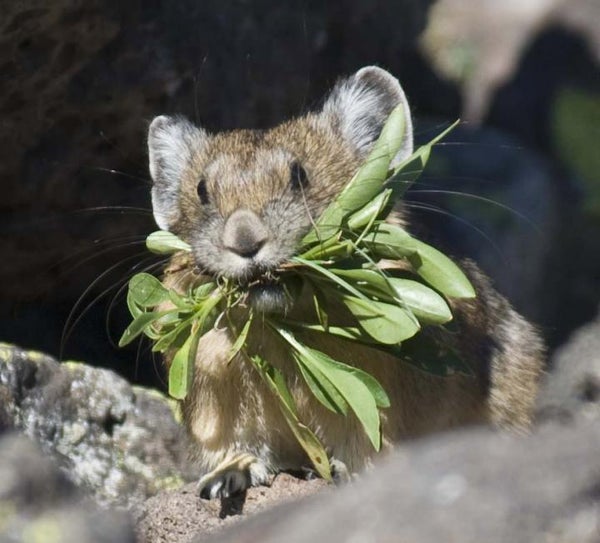

Up in California’s High Sierra, above the dense pine forests, rocky habitats reign. And if you look carefully among the boulders, you might see a pika—a rabbit relative the size of a hamster, with round ears and big eyes.
"Hikers oftentimes see them with little bouquets of wildflowers sticking out of their mouths." Joseph Stewart, a conservation biologist at the University of California Santa Cruz. "Maybe I'm a little biased, other people tell me they're very cute. I find them majestic. I feel like they're the lords of the mountain."
Stewart is also a skilled spotter of pikas. "You could say I've got a little bit of experience with that." Which makes it all the more strange that in five years of surveys—of 64 square miles of high mountain rocky habitats near Lake Tahoe—he found no pikas at all. In an area littered with decades-old pika droppings.
On supporting science journalism
If you're enjoying this article, consider supporting our award-winning journalism by subscribing. By purchasing a subscription you are helping to ensure the future of impactful stories about the discoveries and ideas shaping our world today.
It's relatively pristine habitat, in the center, rather than the edge, of historic pika territory. So Stewart suspects the most likely culprit for this local extinction is rising temperatures, due to climate change. And the mercury's heading higher. "By 2050 we expect there's going to be a 97 percent decline in the area of climatically suitable habitat in the greater Tahoe area." The study is in the journal PLOS ONE. [Joseph A. E. Stewart, Apparent climate-mediated loss and fragmentation of core habitat of the American pika in the Northern Sierra Nevada, California, USA]
Pikas can still be seen elsewhere in Tahoe, and in other parts of the Sierras. Especially further south, where loftier summits allow pikas to roam higher to escape rising temperatures. But Stewart still worries about their eventual fate.
"We're depriving future generations of the ability to see this critter. And pikas have been around longer than humans have been around. What right do we have to cause pikas and all the other species that are vulnerable to climate change to go extinct?"
—Christopher Intagliata
[The above text is a transcript of this podcast.]
