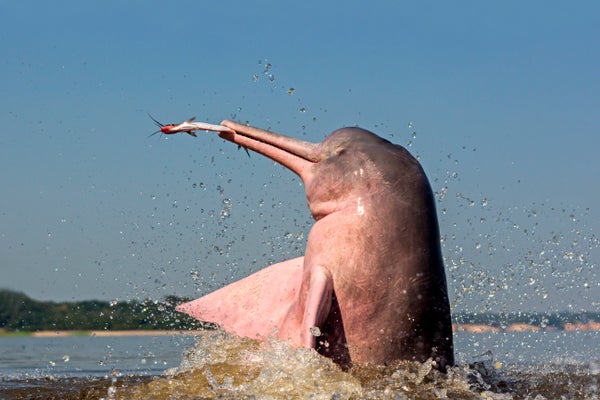
Freshwater dolphins live in many of the world's biggest rivers, from the Amazon to the Ganges, and they differ in many ways from their better-known oceangoing cousins. "They have a flexible neck. They have different types of teeth. They can also move their flippers independently in different directions, so they can swim backwards."
Gabriel Melo-Santos, a marine biologist at the University of St. Andrews in Scotland. “When I decided I was going to be a biologist I decided I wanted to study dolphins. And being born in the Amazon, it was only natural to go for the river dolphins."
He says another thing that sets his study subjects apart from marine dolphins are their calls .
On supporting science journalism
If you're enjoying this article, consider supporting our award-winning journalism by subscribing. By purchasing a subscription you are helping to ensure the future of impactful stories about the discoveries and ideas shaping our world today.
Over several years, Melo-Santos has recorded the sounds of Araguaian river dolphins that came calling at the Mocajuba fish market. That's on Brazil's Tocantins River. Using sound analysis software, his team fished 237 distinct sound types from the recordings—indicating the dolphins have a wide repertoire.
The call collection, published in the journal PeerJ, has only a few whistles. Instead, three quarters of the collected sounds were short two-parters, like this one produced by a female calf as she rubbed her head on her mother's belly. It’s a call that's more similar in structure to the ones orcas and pilot whales make to identify a family or social group than to the social whistles of marine dolphins. [Gabriel Melo-Santos et al, The newly described Araguaian river dolphins, Inia araguaiaensis (Cetartiodactyla, Iniidae), produce a diverse repertoire of acoustic signals]
"These are older lineages, right? So if you understand how these dolphins communicate, we might have a sense to understand how the communication system evolved in different lineages of cetaceans." Meaning perhaps these calls between mother and calf are, like the river dolphins themselves, an evolutionary relic.
—Christopher Intagliata
[The above text is a transcript of this podcast.]
Subscribe to Support Independent Journalism
Great science journalism requires human expertise, time, effort and creativity. And it costs money. That’s why I and the journalists here at Scientific American hope you’ll join our community.
When you subscribe, you are supporting staff and freelance journalists who are passionate about telling science stories that are true, important and compelling. Our editors and reporters are often experts in their fields, which means they understand the nuances of big discoveries and can untangle the breakthroughs from the hype. With a subscription, you are also supporting rigorous fact-checking to ensure the words we publish are precise and accurate. And you’re supporting original illustrations, graphics and photos that bring you closer to an advanced laboratory, an ice sheet in Antarctica or a space mission in orbit. You’re helping us craft other types of high-quality journalism as well: Our newsletters are carefully written, edited and curated by staffers you have or will come to know and love. Our Science Quickly podcast is based on original reporting, collaboration with editors and scientists and exacting production.
Subscriptions keep this engine running so we can continue to deliver thoughtful, rigorous and independent science journalism to you. In an era of viral misinformation, this work is crucial. If you value what we do, I hope you’ll consider joining us as a subscriber