
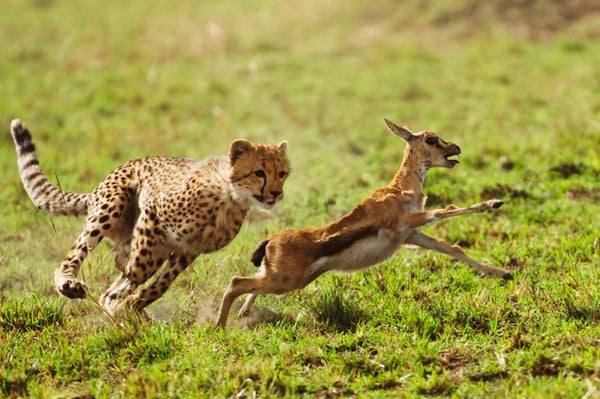

What does panic sound like? <
[Piera Filippi et al., Humans recognize emotional arousal in vocalizations across all classes of terrestrial vertebrates: evidence for acoustic universals]
It was Charles Darwin who first mused about the evolution of emotional expression.
On supporting science journalism
If you're enjoying this article, consider supporting our award-winning journalism by subscribing. By purchasing a subscription you are helping to ensure the future of impactful stories about the discoveries and ideas shaping our world today.
As he wrote in the Descent of Man:
"All the air-breathing Vertebrata necessarily possess an apparatus for inhaling and expelling air.... When the primeval members of this class were strongly excited and their muscles violently contracted, purposeless sounds would almost certainly have been produced."
Now, if producing those seemingly purposeless noises turned out to be beneficial…by warning others of predators, summoning protection, or enticing a mate…the behavior would persist and, over time, become selected for.
Of course, for that to happen, the meanings behind those utterances would have to be clearly understood. To explore this question, researchers asked 75 volunteers to listen to vocalizations produced by nine different species, from black-capped chickadees to American alligators. The recordings included sounds made by animals when they were relatively relaxed…like this hourglass tree frog <
The listeners were then asked to identify which of the paired recordings from each species represented a sound of distress or “emotional arousal.”
The result?
“We found that, yes, humans recognize higher levels of emotional intensity in species which span across all of these classes.”
Piera Filippi of the University of Aix-Marseille in France and the Max Planck Institute for Psycholinguistics in the Netherlands, who led the study.
“Interestingly, we did not find any effect of language background on the human’s accuracy.”
Participants who spoke English, German or Mandarin all did equally well at pointing out which chirps, squeals, and hoots were emotionally charged. They were also able to tell when actors speaking in Tamil, a language none of them had ever heard before, sounded upset.
“The finding thus suggests that humans’ ability to recognize higher levels of emotional intensity in animal vocalizations is biologically universal.”
The listeners seem to be tuning in on the higher frequency of alarm calls, the researchers say. These shifts in pitch are perhaps clearest in the vocalization of infants, such as the piglet <
We’re not necessarily horse whisperers…but it seems we all feel for that little piggy when it goes <
—Karen Hopkin
[The above text is a transcript of this podcast.]
