

The big hurricanes last summer—Harvey, Irma and Maria—knocked out internet service for many residents. But another threat to the internet is just regular old sea level rise.
"Uh, yeah, some is already happening." Carol Barford, a biogeochemist at the University of Wisconsin–Madison. "I mean there's a lot of data out there that shows that sea level on the coast is rising."
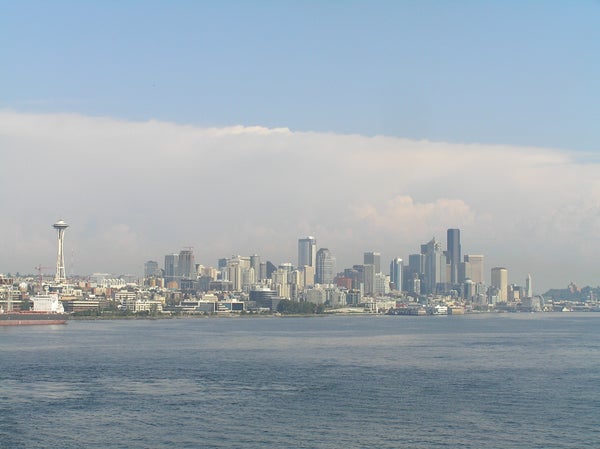
And that, she says, means big problems for internet connectivity in major coastal cities like New York, Miami and Seattle. Barford and her colleagues forecast that danger using a map of global internet networks, and sea level rise data from NOAA.
On supporting science journalism
If you're enjoying this article, consider supporting our award-winning journalism by subscribing. By purchasing a subscription you are helping to ensure the future of impactful stories about the discoveries and ideas shaping our world today.
"So there are two maps, where's the internet stuff and where's the flooding. And when they're superimposed, where they coincide, there are problems."
Using NOAA's extreme sea level rise estimate, recommended for forecasts involving long-term infrastructure like this, the researchers say that 15 years from now, 4,100 miles of fiber-optic cable could be underwater. And 1,100 internet hubs could be surrounded by water. And remember, our land-based infrastructure isn't waterproof, like transoceanic cables are.
"Seawater comes in, and cabling is not meant to work underwater. So signals will be interrupted and dropped. The actual infrastructure itself might deteriorate." The researchers presented the peer reviewed findings at the Applied Networking Research Workshop in Montreal this week. [Ramakrishnan Durairajan, Carol Barford, and Paul Barford, Lights Out: Climate Change Risk to Internet Infrastructure]
They also write that large internet service providers including AT&T, CenturyLink and Inteliquent face the greatest risk. If these predictions play out, internet companies need to harden their networks soon, they say. Or we could lose service during the emergency—right when we need it most.
—Christopher Intagliata
[The above text is a transcript of this podcast.]
