
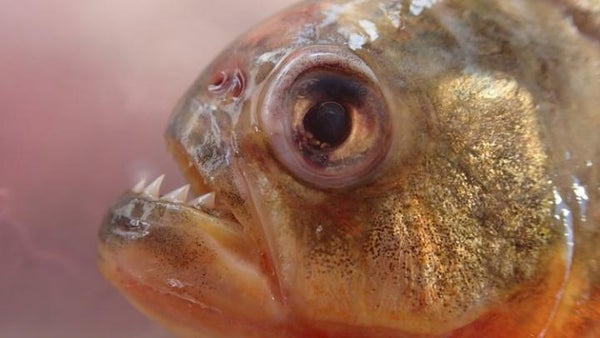

Six years ago, the fish ecologist Rodney Rountree was on a skiff in the Peruvian Amazon. He was holding a piranha in his hand…underwater…in a river filled with other piranhas. Maybe, hungry ones.
"That thought crossed my mind a little bit. The water was essentially no visibility. So I did worry a little bit about that but there was no other way to do it."
The job he needed to do? "Audition them, for sound production." Because Rountree studies the sounds fish make. His nickname—and the name of his company: "The Fish Listener."
On supporting science journalism
If you're enjoying this article, consider supporting our award-winning journalism by subscribing. By purchasing a subscription you are helping to ensure the future of impactful stories about the discoveries and ideas shaping our world today.
So his team would catch a fish, reel it in and identify it. And then Rountree would hold it underwater, near a hydrophone, to capture the sounds it made. Like this one, from a red piranha.
"A lot of people call it a bark. I sometimes thought of it as a honk."
The fish make the sound, he says, by pushing and pulling on their swim bladder with the surrounding muscles. Overall, Rountree auditioned 129 piranhas, of four different species. Along with dozens of other river species, like catfish. And he found that he could differentiate individual piranha species by analyzing factors like pitch and harmonics and number of barks.
His colleague Francis Juanes presented the work at the Acoustical Society of America meeting in Victoria, Canada. [Rodney Rountree, Francis Juanes: Sounds from the Amazon: Piranha and Prey]
Rountree also recorded 10 hours of underwater soundscapes, like this one, captured during a piranha feeding frenzy.
—Christopher Intagliata
[The above text is a transcript of this podcast.]
