
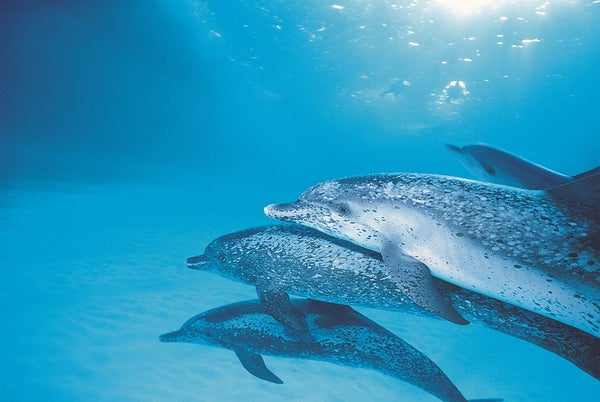

Light doesn't travel well underwater. So dolphins and other toothed whales navigate like bats, using echolocating clicks. <
"They're like lasers of sound they produce out of their forehead, and they bounce them off things the same way bats do, to interpret their environment."
Kait Frasier is an oceanographer at the Scripps Institution of Oceanography. And her studies of underwater clicks include tossing computers, worth $100,000 dollars each, over the side of a ship, into the Gulf of Mexico.
On supporting science journalism
If you're enjoying this article, consider supporting our award-winning journalism by subscribing. By purchasing a subscription you are helping to ensure the future of impactful stories about the discoveries and ideas shaping our world today.
"It just feels so wrong. But a year later you go back, you send out this little ping signal, it goes, doo doo doo doo doo, and that goes out to the instrument and it drops its weights and floats to the surface. And it's this magical moment, like 'I never thought we'd get that back.'"
The waterproof computers have underwater microphones attached…. So when they float back up, they're loaded with a symphony of underwater sounds. Including more than 50 million clicks. <
Frasier used to comb through that audio, staring at the signals, trying to differentiate one from the other. "Yeah, more than i would like to spend my time sifting through."
So she set machine learning algorithms at the data instead… which sifted out seven distinct clicking patterns. And the algorithms were able to identify one species—called Risso's dolphin—by sound alone. The results are in the journal PLOS Computational Biology. [Kaitlin E. Frasier et al., Automated classification of dolphin echolocation click types from the Gulf of Mexico]
Traditional marine mammal surveys scan surface waters from a boat, and extrapolate from there. But this tech might offer an alternative. "Instead of going out on a boat you put this instrument out, and it does this passive acoustic listening for a year, or many years in a row, and you can use that to get better time series of these animals over a long period of time."
If it can figure out how to tease out more individual species types, this survey method might really click.
—Christopher Intagliata
[The above text is a transcript of this podcast.]
