

As you sit round the Christmas tree, consider the TLC you give O Tannenbaum: plenty of water and a relatively comfortable climate. Wouldn't want to dry out the tree, after all. Now consider that in the house we all live in—the planet—we’re hardly giving the same courtesy to your Christmas tree's wild cousins. (Who, I might add, are actually still alive.)
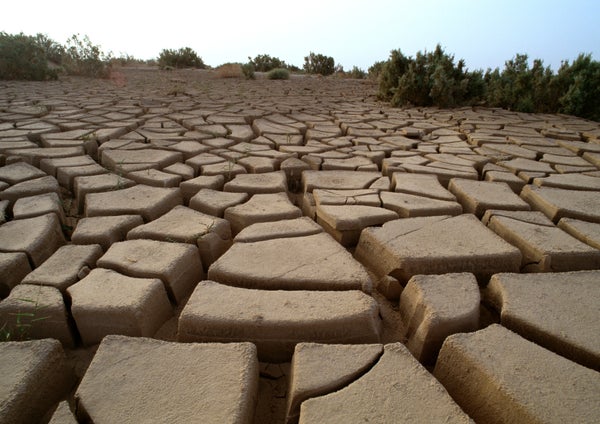
As the planet warms, droughts are getting even drier—and they're getting hotter too. In fact it's getting so bad that researchers are now forecasting that conifers in the arid southwestern United States could be completely wiped out by the end of the century. No more pinyon pines, ponderosas or junipers. No more forests.
On supporting science journalism
If you're enjoying this article, consider supporting our award-winning journalism by subscribing. By purchasing a subscription you are helping to ensure the future of impactful stories about the discoveries and ideas shaping our world today.
"It's definitely a distressing result for all of us. None of us want to see this happen. It's a bummer, honestly." Sara Rauscher, a climate scientist and geographer at the University of Delaware. She and her colleagues gathered data on how real-world evergreens in the southwest respond to drought and heat—they basically starve, unable to carry on photosynthesis or transport water.
The researchers then combined those physiological data with a half dozen projections of how climate change might proceed. "But no matter what model we used, we always saw tree death." Specifically, 72 percent of the trees dead by 2050, and a near-complete annihilation by the year 2100. The results are in the journal Nature Climate Change. [N. G. McDowell et al, Multi-scale predictions of massive conifer mortality due to chronic temperature rise]
But we'll always have Paris, right? "Even if we used a scenario similar to what the Paris accords have agreed upon—so limiting global warming to 2 degrees—we still saw widespread die-off. It happened later in the century, but it still happened." That said, the study does not account for trees' ability to adapt, or whether new populations could find friendlier climes. That is, whether conifers in the southwest can pull up roots fast enough to beat climate change.
—Christopher Intagliata
[The above text is a transcript of this podcast.]
[Scientific American is part of Nature Publishing Group.]
