New Issue: Orbital Catastrophe Ahead? Read Now

Super Bowl Snacks Need These Exercise Equivalents

Charles Platkin, director of the New York City Food Policy Center at Hunter College, published tips on what it would take to burn off the calories we typically consume during the Super Bowl


Getty Images/iStockphoto/Thinkstock Images

Illustration of a Bohr atom model spinning around the words Science Quickly with various science and medicine related icons around the text

Join Our Community of Science Lovers!

Super Bowl Sunday is almost here and there’s one question on everyone’s mind: How can I tackle a plate of chicken wings without adding yardage to my end zone?

Well, Charles Platkin is the director of the New York City Food Policy Center at Hunter College. And he thinks that to make smarter, more splurge-worthy snacking choices we should consider what it would take to burn off the calories we take in.

To that end, Platkin has come up exercise equivalents for some of our favorite couch-side canapes and other nibbles.


On supporting science journalism

If you're enjoying this article, consider supporting our award-winning journalism by subscribing. By purchasing a subscription you are helping to ensure the future of impactful stories about the discoveries and ideas shaping our world today.


Let’s kick things off with a foot-long meatball sub. This marinara-soaked monster, which weighs in at around 900 calories, would take more than an hour-and-a-half of running up and down the stadium steps to work off. And three pieces of KFC at 740 calories would take some 680 touchdown dances. Almost certainly leading to a celebration penalty.

A single tortilla chip, a mere 20 calories, with a scoop of seven-layer dip, another 70 calories, would require a solid 25 minutes of boogying down to Lady Gaga!

Even two handfuls of Chex Mix, which racks up a surprising 280 calories, calls for 30 minutes of jumping up and down after your team scores. And a 450-calorie slice of pizza? Do the wave 2,194 times. But you could get called for interference—by others trying to see the TV.

Now, if you’re still thinking about piling on those wings, each one weighs in at a hefty 95 calories. Add blue cheese dip and 10 wings can hit 1,400 calories. Which would take 149 trips up and down the field to run off.

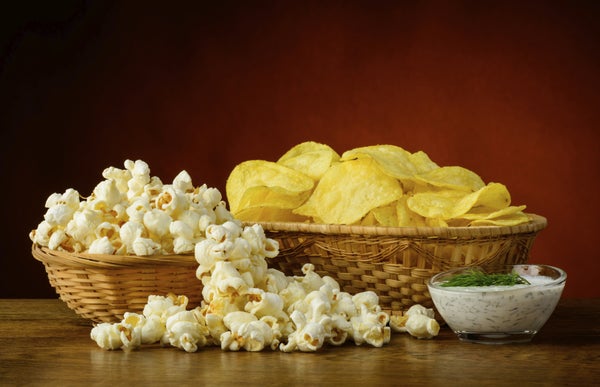
But before conceding defeat, Platkin does offer some pointers to help you beat the Super Bowl spread. Stock up on popcorn, and skip the butter. Drizzle hot sauce on the wings instead of dollops of dip. And do not huddle with your snacks—keep them far enough away so that getting at them makes you put your backfield in motion.

—Karen Hopkin

[The above text is a transcript of this podcast.]

Subscribe to Support Independent Journalism

Great science journalism requires human expertise, time, effort and creativity. And it costs money. That’s why I and the journalists here at Scientific American hope you’ll join our community.

When you subscribe, you are supporting staff and freelance journalists who are passionate about telling science stories that are true, important and compelling. Our editors and reporters are often experts in their fields, which means they understand the nuances of big discoveries and can untangle the breakthroughs from the hype. With a subscription, you are also supporting rigorous fact-checking to ensure the words we publish are precise and accurate. And you’re supporting original illustrations, graphics and photos that bring you closer to an advanced laboratory, an ice sheet in Antarctica or a space mission in orbit. You’re helping us craft other types of high-quality journalism as well: Our newsletters are carefully written, edited and curated by staffers you have or will come to know and love. Our Science Quickly podcast is based on original reporting, collaboration with editors and scientists and exacting production.

Subscriptions keep this engine running so we can continue to deliver thoughtful, rigorous and independent science journalism to you. In an era of viral misinformation, this work is crucial. If you value what we do, I hope you’ll consider joining us as a subscriber

Thank you,

Jeanna Bryner, Editor in Chief, Scientific American

Subscribe