

Bourbon whiskey doesn't have to be made in Bourbon County, Kentucky. But it does have to be produced from at least 51 percent corn and be aged in unused charred oak barrels.
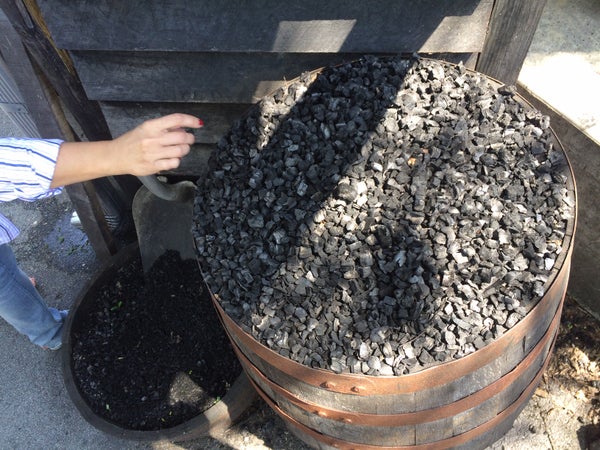
Tennessee whiskey, on the other hand, must be made in Tennessee, as the name implies. And in addition to the steps that create a bourbon, the distilled whiskey undergoes another one called the Lincoln County Process, "where you take your fresh whiskey distillate and you filter it through sugar maple charcoal. It's also called charcoal mellowing."
Trent Kerley is a graduate student in food science at the University of Tennessee Institute of Agriculture. And just for the record: "Personally, I prefer bourbon whiskeys."
On supporting science journalism
If you're enjoying this article, consider supporting our award-winning journalism by subscribing. By purchasing a subscription you are helping to ensure the future of impactful stories about the discoveries and ideas shaping our world today.
Filtration through charcoal made from the wood of the sugar maple tree is known to mellow the flavor of Tennessee whiskeys like Jack Daniels. But the underlying chemistry was a bit more of a mystery. So Kerley teamed up with the Sugarlands Distilling Company in Gatlinburg, Tennessee to put their whiskey to the test.
He used gas chromatography, coupled with human sniffing, to identify about three dozen aromatic compounds contributing to the whiskey's flavor profile. He then tracked the quantities of four of them—two branched alcohols and two ethyl esters—before and after the Lincoln County Process. Turns out the charcoal stripped out a third of the branched alcohols and nearly half of the ethyl esters. Kerley's advisor, food chemist John Peter Munafo:
"Take-home message is that branched alcohols and the ethyl esters that we analyzed in this study decreased, and the distillate was smoother tasting and less harsh after the Lincoln County Process." The researchers presented the work at an American Chemical Society meeting in Orlando. [Trenton Kerley, John Peter Munafo, AGFD 46: Changes in key odorants by the Lincoln County process (Tennessee whiskey)]
The goal, Kerley says, is to take some of the guesswork out of making great whiskey—especially when the stakes are high. "There was a head distiller at one of the big bourbon distilleries who said, you really only get two chances to make a 15-year-old whiskey." Munafo again: "Basically we're just optimizing the tools to help the distillers get to the flavor profile they want."
As for the flavor profile he wants? "Well, I'm not saying Tennessee whiskey is better. It just is."
—Christopher Intagliata
[The above text is a transcript of this podcast.]
