
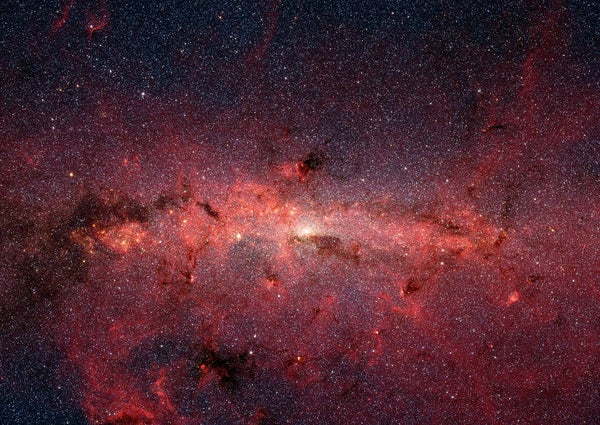

Christopher Intagliata: When you look up at the Milky Way, you're gazing at the galactic equivalent of Rome. A metropolis of stars, with layers upon layers of history—just like The Eternal City. So says the astronomer Hans-Walter Rix.
Hans-Walter Rix: There were glory days, there were disasters, and all of these things kind of happen in the life of galaxies. And the Milky Way is just the one galaxy where we can look at star by star so you can kind of see individual episodes in actual detail.
Intagliata: Now Rix and a colleague at the Max-Planck Institute for Astronomy in Germany have indeed gone star by star… determining the ages of nearly a quarter million stars in the Milky Way. That work has allowed them to reconstruct some of the major life events in the galaxy's evolution, over its 13 billion years of existence.
On supporting science journalism
If you're enjoying this article, consider supporting our award-winning journalism by subscribing. By purchasing a subscription you are helping to ensure the future of impactful stories about the discoveries and ideas shaping our world today.
Rix: What it showed is that indeed the youth and childhood of the Milky Way was turbulent… but actually afterwards we've lived an enormously sheltered life compared to most other galaxies. Gas drizzled in, and the suburbs grew peacefully and sprawled.
Intagliata: The astronomers say that the galaxy's thick disk began to form about 13 billion years ago, just 800 million years after the Big Bang. Then, around 11 billion years ago, a cataclysmic collision occurred: the Gaia-Enceladus satellite galaxy crashed into the Milky Way.
Rix: And just at the same time, there was a huge burst of star formation, or a large increase of star formation in our own Milky Way. And that suggests—doesn't prove—that the perturbance that this in-falling satellite created, caused a lot of gas that was in our Milky Way to form stars.
Intagliata: The details are in the journal Nature. [Maosheng Xiang & Hans-Walter Rix, A time-resolved picture of our Milky Way’s early formation history]
Now, none of this is a total surprise—people have simulated the Milky Way's formation before.
Rix: So I would say really what our work has done is it just shows it clearly a long-suspected picture is coming into focus.
Intagliata: In other words—this work lays out a more definitive playbill of the acts in this galactic drama.
[The above text is a transcript of this podcast.]
