

Some birds are relatively easy to study. Ross Crates studies the ones that aren’t. He’s part of the Difficult Bird Research Group at the Australian National University.
“All our study species are quite challenging to study for various reasons, mostly because they’re really rare and highly mobile.”
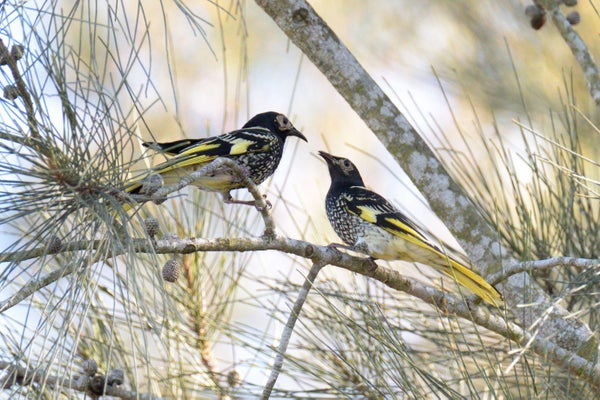
One of those “difficult birds” is the critically endangered regent honeyeater. They’re medium-sized songbirds—with bright yellow tails and black-and-white chests. And though they once roamed Australia in flocks of hundreds, fewer than 300 remain in the wild today.
On supporting science journalism
If you're enjoying this article, consider supporting our award-winning journalism by subscribing. By purchasing a subscription you are helping to ensure the future of impactful stories about the discoveries and ideas shaping our world today.
Crates and his team tracked the birds over a five-year period. If they encountered a male, they’d record his song.
[CLIP: Proper song]
And they noted whether the males were paired up with females.
They found that a quarter of the birds sang variations of the traditional honeyeater song. And 12 percent of the birds weren’t singing honeyeater songs at all. They were parroting different species’ songs—like this ...
[CLIP: Little friarbird]
... or this.
[CLIP: Little wattlebird]
That could mean bad news for the birds’ future—because males singing those untraditional songs were also less likely to be paired up with a mate, compared to their counterparts who sang the standard tune.
“As females breed less, then there’s obviously fewer males in that generation to teach the next generation. A higher proportion of males sing weird songs. And you get a bit of a positive feedback toward extinction.”
The work appears in the Proceedings of the Royal Society B. [Ross Crates et al., Loss of vocal culture and fitness costs in a critically endangered songbird]
Crates says the honeyeaters’ loss of songs equates to a loss of culture.
“It’s a complete sort of, you know, animal equivalent of the loss of Indigenous languages, whether that be Native American languages or Aboriginal Australian languages here.”
He says he hopes it serves as a warning that all is not well in Australia’s natural world—and that we must do more to tackle climate change and conservation if we hope to save it.
—Christopher Intagliata
[The above text is a transcript of this podcast.]
