

Karen Hopkin: This is Scientific American’s 60-Second Science. I’m Karen Hopkin.
Ever get the feeling that your cat is judging you?
[Cat meows]
On supporting science journalism
If you're enjoying this article, consider supporting our award-winning journalism by subscribing. By purchasing a subscription you are helping to ensure the future of impactful stories about the discoveries and ideas shaping our world today.
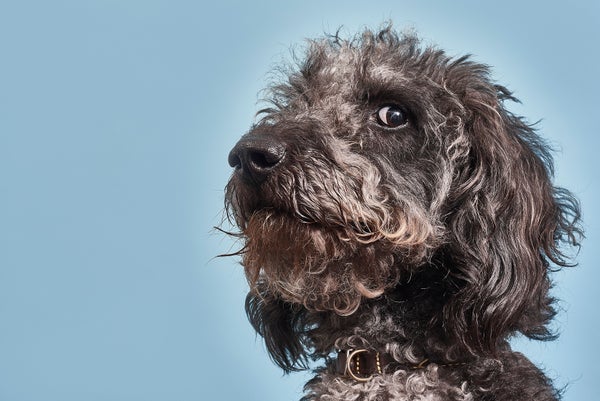
Hopkin: Well, you’re in for a surprise. Because it’s actually your pooch who might be viewing you with a critical eye.
[Dog barking in experiment]
Hopkin: That’s according to a study that shows that dogs can assess human aptitude…and will look toward people who seem to know what they’re doing. The work appears in the journal Behavioral Processes.
Hitomi Chijiiwa: Our aim was to test whether dogs are sensitive to humans’ competence levels. And whether they evaluate humans on this trait.
Hopkin:Hitomi Chijiiwa is an assistant professor at Osaka University. If critiquing people’s proficiency seems an odd job for a pup, it may not be all that far fetched. Canines have spent more than 10,000 years by our sides.
Chijiiwa: [So] Dogs are highly sensitive to human behavior.
Hopkin: And they pay particular attention to things like how cooperative we are.
Chijiiwa: For example, our previous study showed that dogs avoid people who refuse to help their owner.
Hopkin: So Chijiiwa and her colleagues got to wondering whether dogs might also rate us in terms of our skillfulness. Particularly if those skills might come in handy for our four-footed little friends. So they set up a simple experiment.
Chijiiwa: We showed 60 dogs two persons manipulating transparent containers. One person is competent.
Hopkin: That person was able to pop open the top after just a couple of twists.
[Sound from experiment]
Chijiiwa: Whereas the other person is incompetent and they failed at this task.
Hopkin: That person tried to open the lid, then gave up. The actors repeated the performance on a second container, with the same results: the competent person succeeded, the other, not so much.
Then the researchers handed both actors a third container. In some trials, this container was empty. In others, it contained a treat. And what they found was that female dogs spent more time gazing expectantly at the person who had previously demonstrated container-opening know-how.
Chijiiwa: And they were more likely to approach the competent person.
Hopkin: But only when they thought they might get free food.
Chijiiwa: Dogs in the empty condition showed no preferences.
Hopkin: (Although one little cutie with a bow on her head did bark at all the containers, regardless of their contents.)
[Audio of dog barking through experiment]
Hopkin: So, why would females be more censorious observers of people’s performances than males?
Chijiiwa: Female superiority in the social cognitive domain has been reported across many mammalian species including humans.
Hopkin: In other words, in many cognitive studies, furry females seem to show a higher social IQ than mammalian males. And sex differences have been seen in other pup studies.
Chijiiwa: For example, females look at their owners more frequently and longer than males when facing unsolvable task. [And] Female dogs solve significantly more tasks than males in social learning task.
Hopkin: So…next time Fifi looks at you with those puppy dog eyes…you might be thinking, what a good dog! But she might be thinking, Meh, you could do better.
For Scientific American’s 60-Second Science, I’m Karen Hopkin.
[Dog barking]
