Why Do Some Comets Dazzle While Others Fizzle?
A comet’s brightness depends on how it’s made, how and when we see it, and even a bit of unpredictable luck

Why Do Some Comets Dazzle While Others Fizzle?
A comet’s brightness depends on how it’s made, how and when we see it, and even a bit of unpredictable luck

NASA’s Moon Race Looks like a Losing Bet
Former NASA officials warn that the U.S. looks poised to lose its self-declared race to beat China to the moon


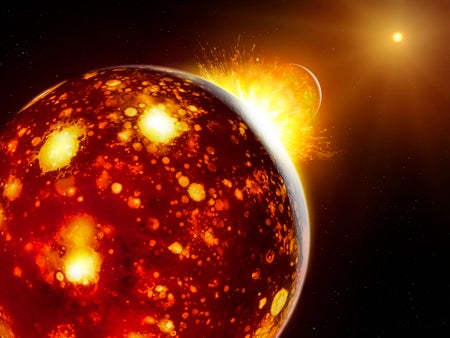
Have Astronomers Finally Found an Exomoon?
Data from the James Webb Space Telescope and other observatories suggests a supervolcanic exomoon may lurk around the giant exoplanet WASP-39b

How to See the Earth and Moon from Mars
If you pick the right time, our home world and our moon could be easily visible from the Red Planet

Saturn’s moon Enceladus has complex, life-friendly chemistry
A fresh analysis of old data has found rich organic chemistry within the hidden ocean of Saturn’s moon Enceladus

Asteroid ‘Families’ Reveal Hidden Histories and Impact Risks across the Solar System
Many asteroids are related, but their family trees can be hard to trace

The Moon Is Rusting—Thanks to ‘Wind’ Blown from Earth
Lunar minerals can rust when bombarded with high-energy oxygen particles, experiments show

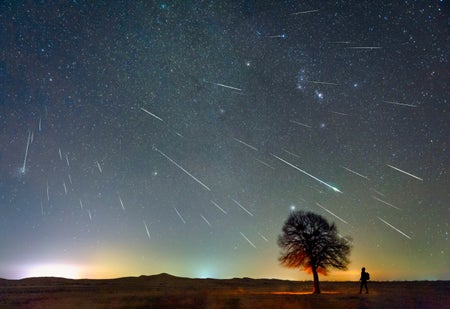
If This Asteroid Hits the Moon, Watch for Shooting Stars and Stricken Satellites
The 60-meter asteroid 2024 YR4 has a 4 percent chance of hitting the moon. Could such a lunar collision create a dangerous new meteor shower?

These Tiny Disks Will Sail on Sunlight into Earth’s Mysterious ‘Ignorosphere’
With no fuel or engines, tiny explorers will surf sun-warmed air alone to explore high in the skies of Earth and Mars

Can Cosmic Rays Help Alien Life Thrive?
Beneath the surfaces of distant planets, microbes might subsist on harsh radiation rather than starlight, a new study suggests

One Year after Scientific American’s First Issue, the Solar System Grew by a Planet
Neptune’s discovery was a race that ended not long after this magazine came to be

NASA Budget Cuts Could End U.S. Exploration of the Outer Solar System
The U.S. planetary science community is sounding the alarm about plans to discard a nuclear technology that has powered dozens of NASA missions over the past 50 years