New Issue: Orbital Catastrophe Ahead? Read Now

The sun just unleashed its most powerful solar flare in years

The sun is experiencing a violent solar storm, releasing one of the strongest solar flares seen in the past 30 years

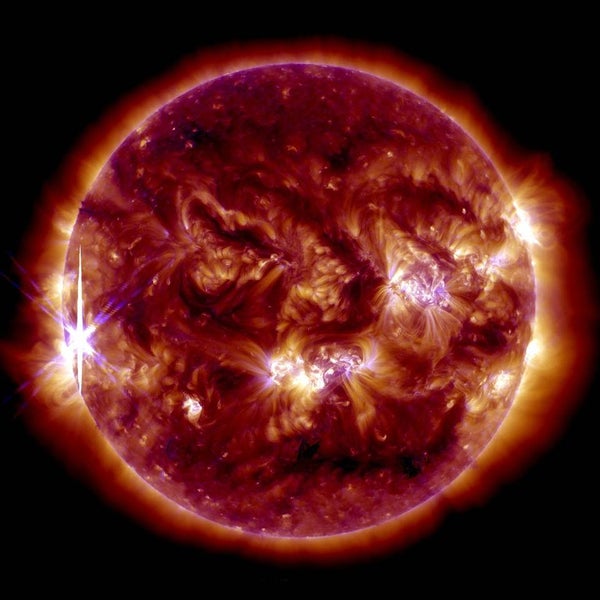
Image of the sun showing turbulent flows of plasma and a bright solar flare.

An X-class solar flare captured on camera by NASA’s Solar Dynamics Observatory in 2013. The sun blasted out four such flares in the past two days.

NASA/SDO/GSFC

Join Our Community of Science Lovers!

The sun is putting on a show. On Sunday the star unleashed several strong and bright solar flares, including one of the most powerful eruptions seen in decades.

Far from the steadily glowing orb we sometimes picture, the sun’s surface is made up of roiling plasma thrown about by twisting magnetic fields. When these fields snap, they can throw out huge bursts of energy and charged particles into space—a solar flare.

NASA’s Solar Dynamics Laboratory caught one such outburst yesterday at 7:33 A.M. EST and gave it an X-class ranking—the most intense. Throughout last night, three more X-class flares followed amid dozens of smaller spurts of activity. But the crescendo came at 6:37 P.M. EST, when the sun let rip an X8.1-class burst. That makes it the brightest flare since October 2024 and among the top 20 since 1996, according to SpaceWeatherLive.com.


On supporting science journalism

If you're enjoying this article, consider supporting our award-winning journalism by subscribing. By purchasing a subscription you are helping to ensure the future of impactful stories about the discoveries and ideas shaping our world today.


Astronomers expect most of the expelled plasma to pass Earth sometime on Thursday. Specks of it could hit our atmosphere, potentially producing the spectacular celestial display the northern lights. The National Oceanic and Atmospheric Administration’s Space Weather Prediction Center is carefully monitoring the region of the sun that is responsible for the flares, with more expected activity yet to come.

The recent outbursts are the latest in an unusually tempestuous period for our star. The sun’s activity fluctuates on an 11-year time line, and while the star is believed to be beyond the peak of its current solar cycle, strong solar flares may continue for some time as it winds down.

Subscribe to Support Independent Journalism

Great science journalism requires human expertise, time, effort and creativity. And it costs money. That’s why I and the journalists here at Scientific American hope you’ll join our community.

When you subscribe, you are supporting staff and freelance journalists who are passionate about telling science stories that are true, important and compelling. Our editors and reporters are often experts in their fields, which means they understand the nuances of big discoveries and can untangle the breakthroughs from the hype. With a subscription, you are also supporting rigorous fact-checking to ensure the words we publish are precise and accurate. And you’re supporting original illustrations, graphics and photos that bring you closer to an advanced laboratory, an ice sheet in Antarctica or a space mission in orbit. You’re helping us craft other types of high-quality journalism as well: Our newsletters are carefully written, edited and curated by staffers you have or will come to know and love. Our Science Quickly podcast is based on original reporting, collaboration with editors and scientists and exacting production.

Subscriptions keep this engine running so we can continue to deliver thoughtful, rigorous and independent science journalism to you. In an era of viral misinformation, this work is crucial. If you value what we do, I hope you’ll consider joining us as a subscriber

Thank you,

Jeanna Bryner, Editor in Chief, Scientific American

Subscribe