New Issue: Science’s Impossible Questions. Read Now

Sun Continues Celestial Fireworks Display with Powerful Solar Flare

The same region on the sun that’s responsible for this week’s stunning auroral display just erupted in another powerful solar flare early on Friday morning

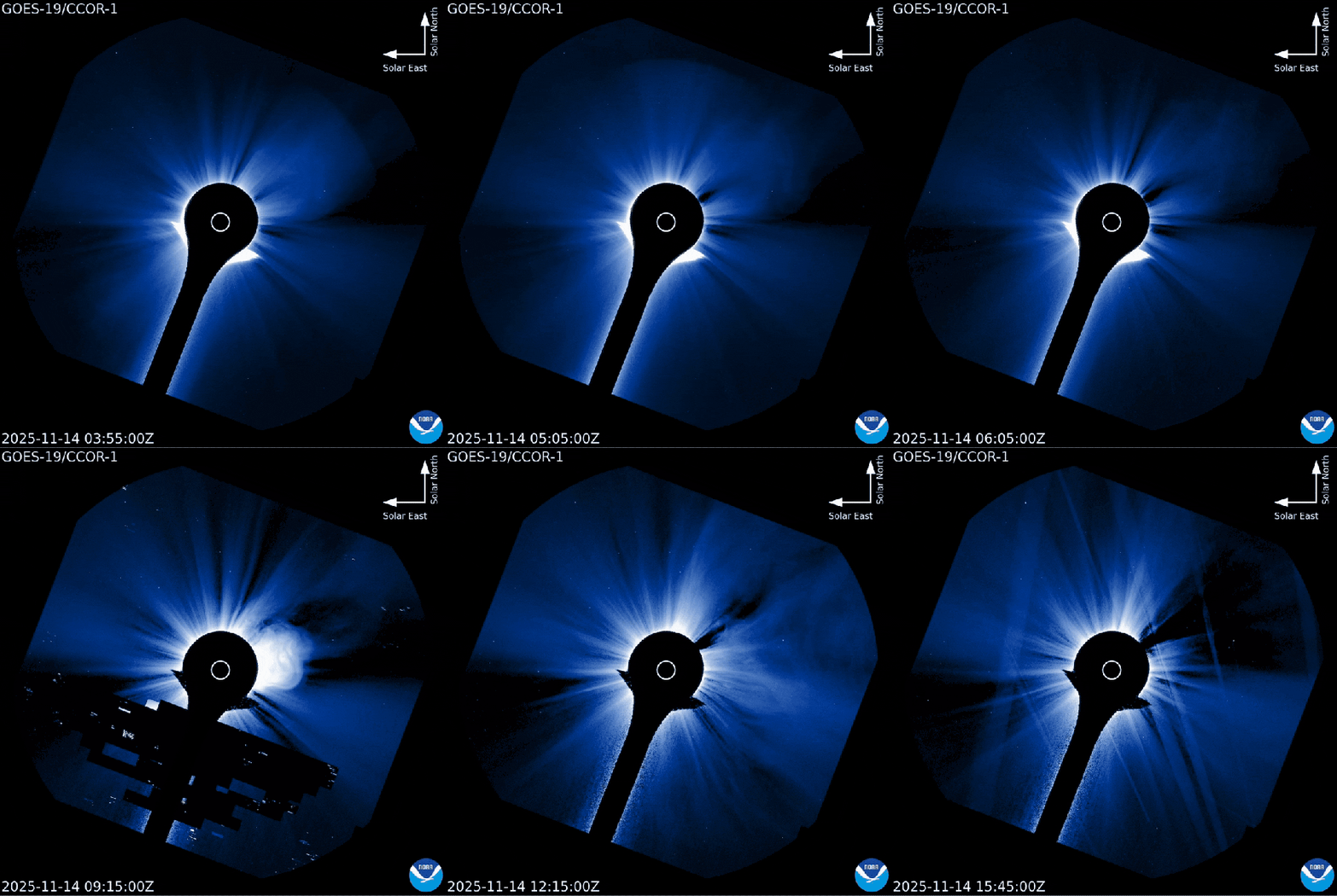
A visualization of a coronal mass ejection from the sun rendered in a blue tint with in a satellite loop.

NOAA Space Weather Prediction Center

Join Our Community of Science Lovers!

The same active region of the sun that produced stunning auroras that were visible as far south as Mexico earlier this week has erupted again.

On Friday the sun released a powerful, X4.0-class solar flare—a parting blow from the dynamic active region 4274 (AR4274), which is rotating toward the far side of our star. Solar flares are ranked by strength, with X-class flares being the most powerful.

Following the flare came a coronal mass ejection (CME), which is when the sun shoots out blobs of solar plasma and magnetic field that—if they reach Earth—can interact with our planet’s atmosphere, triggering auroras. It’s unclear whether today’s outburst will hit Earth—CMEs travel at varying speeds, with some taking days to cross the distance between the sun and our planet.


On supporting science journalism

If you're enjoying this article, consider supporting our award-winning journalism by subscribing. By purchasing a subscription you are helping to ensure the future of impactful stories about the discoveries and ideas shaping our world today.


According to the National Oceanic and Atmospheric Administration’s Space Weather Prediction Center, it is possible that northern parts of the contiguous U.S. could see auroras on Friday evening.

Although AR4274 will be unable to impact Earth on the sun’s far side, the star’s approximately 27-day spin may carry the active region back within firing range.

This week’s outbursts were not out of the ordinary for the sun, which is currently around the peak of its 11-year solar cycle of activity.

The exact times of solar maximum—and its opposite, solar minimum—are generally determined months after the fact and are based exclusively on the number of sunspots visible on our star. Powerful solar outbursts, however, often continue throughout the initial years of the declining phase of the activity cycle.

Meghan Bartels is a science journalist based in New York City. She was previously a senior reporter at Scientific American. Before that she spent more than four years as a writer and editor at Space.com, as well as nearly a year as a science reporter at Newsweek, where she focused on space and Earth science. Her writing has also appeared in Audubon, Nautilus, Astronomy and Smithsonian, among other publications. She attended Georgetown University and earned a master’s degree in journalism at New York University’s Science, Health and Environmental Reporting Program.

More by Meghan Bartels

Subscribe to Support Independent Journalism

Great science journalism requires human expertise, time, effort and creativity. And it costs money. That’s why I and the journalists here at Scientific American hope you’ll join our community.

When you subscribe, you are supporting staff and freelance journalists who are passionate about telling science stories that are true, important and compelling. Our editors and reporters are often experts in their fields, which means they understand the nuances of big discoveries and can untangle the breakthroughs from the hype. With a subscription, you are also supporting rigorous fact-checking to ensure the words we publish are precise and accurate. And you’re supporting original illustrations, graphics and photos that bring you closer to an advanced laboratory, an ice sheet in Antarctica or a space mission in orbit. You’re helping us craft other types of high-quality journalism as well: Our newsletters are carefully written, edited and curated by staffers you have or will come to know and love. Our Science Quickly podcast is based on original reporting, collaboration with editors and scientists and exacting production.

Subscriptions keep this engine running so we can continue to deliver thoughtful, rigorous and independent science journalism to you. In an era of viral misinformation, this work is crucial. If you value what we do, I hope you’ll consider joining us as a subscriber

Thank you,

Jeanna Bryner, Editor in Chief, Scientific American

Subscribe