MathematicsApril 1, 2021
The Enduring Appeal of Tic-Tac-Toe
Video produced in partnership with The Great Courses. All Great Courses video content is available only to subscribers with the password sent via email.
The Enduring Appeal of Tic-Tac-Toe
Video produced in partnership with The Great Courses. All Great Courses video content is available only to subscribers with the password sent via email.
Halley's Comet Can Help Us Understand These Uncertain Times
The work of decoding the cosmic traveler has surprising relevance right now
Experience Seven Minutes of Terror in New Perseverance Mars Rover Landing Video
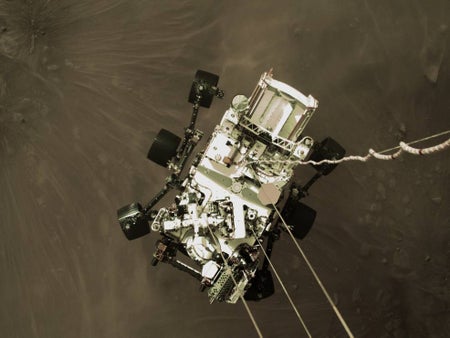
Last week’s pinpoint touchdown of NASA’s Mars Perseverance rover in Jezero Crater was historic for many reasons, chief among them the epochal nature of the mission’s task of seeking signs of ancient life—and caching relevant samples for eventual return to Earth. But even if the rover finds no evidence of Martian microbes during its operations, it will have still produced another spectacular “first” for the textbooks, which NASA officials unveiled today: An unprecedented look at the “seven minutes of terror” between Perseverance’s fiery plunge through the planet’s skies and its coming to rest on solid ground far below. This is the first ever high-definition video of atmospheric entry, descent and landing on another world.
Perseverance’s predecessor Curiosity recorded snippets of the final stages of its Mars landing in 2012 that resulted in a short stop-motion video, and in 2005 the Cassini mission’s Huygens lander beamed back images and telemetry data from its chilly descent to Saturn’s moon Titan that were later used to construct remarkable visualizations. And there is, of course, no shortage of lunar landing footage from the Apollo missions of yore. But never before has a spacecraft captured the entire sequence of an otherworldly landing in such lush detail. More than mere eye candy, this data could prove crucial for the design of future, more ambitious voyages to the Red Planet’s surface, which is considered to be one of the solar system’s most technically challenging landing destinations.
Here is NASA's livestream on the footage.
Video credit: NASA/JPL-Caltech
A Visual Guide to the New Coronavirus Variants
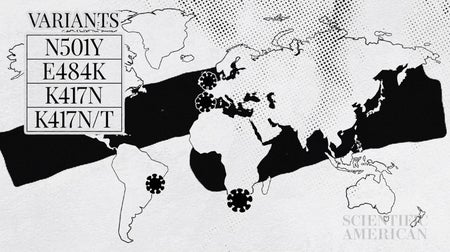
The SARS-CoV-2 coronavirus seems to be suddenly acquiring mutations at a rapid rate. The most worrying variants, first discovered in South Africa and Brazil, increase the virus’s contagiousness and may even help it evade the human immune system. These characteristics are helping the new variants outcompete the original virus, allowing them to spread quickly around the world.
Viruses, including SARS-CoV-2, are constantly evolving and acquiring mutations that don’t affect the virus much. The reason public health experts are concerned is that the new mutations improve the virus’s spike protein, which helps the pathogen enter cells and is the target of most vaccines. If the spike protein evolves sufficiently, the virus may eventually be able to reinfect individuals who have already had COVID-19 or been vaccinated against it.
But scientists say it will likely be years before the vaccine stops working entirely—if it ever does. In the meantime, social distancing remains the best way to fight the new mutants. After all, the more viruses that exist in the world, the greater the chance that one will evolve a dangerous mutation.
In this video, we explain what the new variants actually are, how they arise and spread, and what they could mean for the future of our ability to vaccinate ourselves against the virus.
Misconceptions about Wildfires Are Fueling the Problem
The 2020 wildfire season was the worst in California’s recorded history, with more than four million acres burned and almost 10,500 structures destroyed across the state. The fires were heavily covered by the news media, and some reportssuggested California had suffered apocalyptic devastation and permanent loss. But the more complicated reality of fire’s long-term impact on forests is often poorly reported and misunderstood.
In this video, we talk to experts who say many accounts of California’s blazes sensationalize the extent of forest devastation while paying less attention to fire’s crucial role in nature.
Chad Hanson is a fire ecologist and director of the John Muir Project, an environmental group that advocates for drastic changes in state and national fire policy. He says fire is a natural and unstoppable reality in California. Hanson believes that in some cases, the state’s forests would be healthier and more resilient if certain fires were allowed to burn.
Another expert also notes that to understand 2020 in context, we need to take a very long view of fires in the forest: Valerie Trouet, a researcher who studies tree rings at the University of Arizona, has observed evidence of wildfires in giant sequoias in California dating back almost 3,000 years. She says that although today’s fires sometimes burn more intensely, they used to burn longer and over much larger areas.
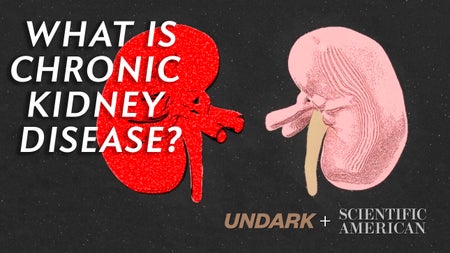
What Is Chronic Kidney Disease, and How Might It Affect You?
In the U.S., a third of Americans are at risk of chronic kidney disease, and age is a major factor. More than half of Americans older than 75 are thought to have some sort of kidney damage. Here is what happens when you have it. Read the full five-part series in partnership with Undark: “Profit and Loss: America on Dialysis.”
Artificial Intelligence Is Now Shockingly Good at Sounding Human
Synthetic voices have become ubiquitous. They feed us directions in the morning, shepherd us through phone calls by day and broadcast the news on smart speakers at night. And as the technology used to make them improves, these voices are becoming more and more human-sounding. This is the final frontier in synthetic speech: replicating not just what we say but how we say it.
Rupal Patel heads a research group at Northeastern University that studies speech prosody—the changes in pitch, loudness and duration that we use to convey intent and emotion through voice. “Sometimes people think of it as the icing on the cake,” she explains. “You have the message, and now it’s how you modulate that message, but I really think it’s the scaffolding that gives meaning to the message itself.”
Patel says she grew interested in prosody after finding it was the only element of vocal communication that seemed to be available to people with some kinds of severe speech disorders. These patients were able to make expressive sounds even if they could not speak clearly. In 2014 Patel founded a company to build custom synthetic voices for nonspeaking individuals. VocaliD has since expanded to commercial brands and influencers.
Synthetic speech has come a long way over the years. At age nine, Siri is the oldest virtual assistant—but in the world of speaking machines, she’s a baby. People have been trying to synthesize speech since at least the 18th century, when an Austro-Hungarian inventor built a crude replica of the human vocal tract that could articulate entire phrases (albeit in a monotone).
Current machine-learning techniques can model human speech, complete with awkward pauses and lip smacks. Still, training on thousands of samples per second is prohibitively expensive for most real-world systems. Researchers, including those at VocaliD, are continually implementing newer and more efficient methods.
But even as the remaining gaps between human and synthetic speech are steadily closing, truly lifelike prosody continues to elude even the most sophisticated systems. Maybe what’s still missing requires machines not only to mimic humans but also to feel like us.
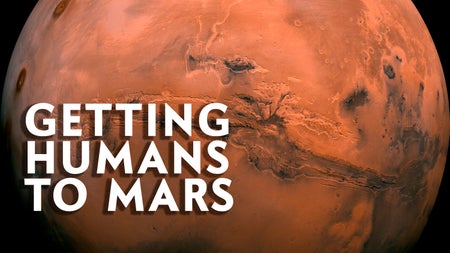
The Future of Mars Exploration
Join Scientific American for a conversation about the next steps in humanity’s reconnaissance of Mars. Featuring Casey Dreier, senior space policy adviser at the Planetary Society, and space and physics editor Lee Billings, this deep dive will begin with an overview of NASA’s upcoming Perseverance rover—slated to land on Mars in February 2021 to search for signs of past and present life and to gather samples for future return to Earth.
Dreier and Billings will also discuss the “post-Perseverance” future in which space agencies and private companies may pursue major shifts in Mars exploration strategies and how those plans could forever change our understanding of—and relationship with—the Red Planet.

Bumblebees’ Self-Image Gets Them through Tight Spots
Sridhar Ravi was outdoors with his colleagues on a summer day in Germany when a group of bumblebees grabbed his attention.
As the bees made their way from flower to flower, they skillfully flew between obstacles, dodging branches and shrubs. These actions seemed to require a complex awareness of one's physical body in relation to one’s environment that had only been proven to exist in animals with large brains.
To examine this, a team of researchers at Australia’s University of New South Wales, Canberra, led by Ravi, set up a hive of bumblebees inside their laboratory. The bees could come and go via a tunnel, which could be partially blocked with an adjustable barrier. Ravi and his team made the gap progressively smaller over time, and observed how the bees’ reactions changed.
The study, published in the Proceedings of the National Academy of Sciences, found the bumblebees measured the gap by flying side-to-side to scan it. When the gap became narrower than their wingspan, the bees took a longer time to scan the opening. And then they did something remarkable: they turned their bodies to fly through sideways. Some of the bees’ bodies did bump the sides of the narrowed opening—but every one of the 400 recorded flights through the gap was a success.
“Over thousands of years nature has coded insects with some amazing attributes,” Ravi says. “Our challenge now is to see how we can take this and apply similar coding to future robotic systems, enhancing their performance in the natural world.”

Vaping Industry Echoes Big Tobacco’s Misleading Call for Science
To understand the battle over e-cigarettes, one must look to history—and big tobacco

A Cosmic Video Miniseries to Ponder Gravity, the Universe and Everything
Earthly matters got you stressed? Here is an opportunity to elevate your mind above the terrestrial din with three cosmic questions
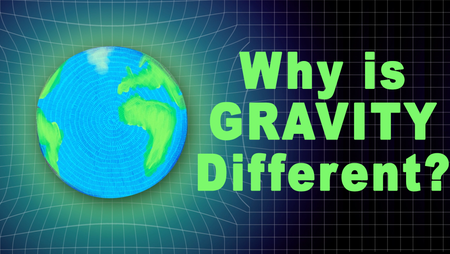
To Understand Gravity, Toss a Hard Drive into a Black Hole
We probably think we know gravity pretty well. After all, we have more conscious experience with this fundamental force than with any of the others (electromagnetism and the weak and strong nuclear forces). But even though physicists have been studying gravity for hundreds of years, it remains a source of mystery.
In our video Why Is Gravity Different? We explore why this force is so perplexing and why it remains difficult to understand how Einstein’s general theory of relativity (which covers gravity) fits together with quantum mechanics.
Gravity is extraordinarily weak and nearly impossible to study directly at the quantum level. We cannot scrutinize it using particle accelerators like we can with the other forces, so we need other ways to get at quantum gravity.
Enter black holes. In a paper in the early 1970s the late physicist Jacob Bekenstein investigated the question of what happens to entropy—a measure of disorder, or randomness, in a system—when matter succumbs to a black hole’s massive gravitational pull and falls through its event horizon.
Bekenstein noted that the matter’s entropy seems to disappear inside the black hole. Yet this would violate the second law of thermodynamics, which states two things: information cannot be destroyed, and entropy can only increase. Thus the entropy of the black hole must compensate for the loss. Bekenstein argued that this black hole entropy must not be proportional to the black hole’s volume, but to the area of its event horizon.
If we are describing the contents of black holes in terms of area instead of volume, we should think about laws of physics in terms of area as well. This would mean a theory of everything (gravity included) should be able to play out in fewer than three spacetime dimensions.
Now let’s imagine the information that describes the state of the entire universe—all stored on a single hard drive. And then throw that hard drive into a black hole. The stored information cannot be lost, so it must be contained in the surface area of the black hole (albeit scrambled).
This scenario leads to a dramatically new way of thinking in which the universe could effectively be a hologram, a seemingly 3-D object that is actually just a projection from a 2-D surface. Our ostensibly three-dimensional experience of the world would then be an illusion, convincingly generated by a fundamentally lower-dimensional reality.
Maybe we’re all just paper-thin cutouts drifting in gravity’s cosmic breeze.