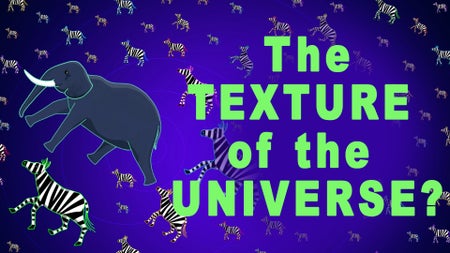
The Big Bang, Zebras and the Texture of Our Universe
What do zebras have to do with the structure of the cosmos? Imagine a single zebra in your mind. With twitching ears, tufted hair, and a visual interference pattern wrapped over muscle and skin, the animal has its own contours, which are easy to make out up close. But get a large group of zebras together (a dazzle, by definition), and the individuals blend and meld into a seemingly homogeneous sea of heads, hoofs and stripes, especially when viewed from a great distance. The matter in the universe, it seems, dazzles in much the same way.
In this video, How the Big Bang Governs the Texture of Our Universe, we explore the concept of cosmic inhomogeneities—using zebras as an analogy for clumps of matter scattered throughout the universe. Animator Lottie Kingslake depicts these whimsical and familiar characters as they graze and form larger and larger groups similarly to how matter is pulled together in galaxies. We were inspired by the color palette of Marylyn Dintenfass’s paintings, which make up the backdrop in the live-action portion of the video.
This visual rendering takes up a fundamental question about the texture of space: Is it smooth or bumpy? The answer is that it is both. It is homogeneous, or smooth, when viewed from vast distances but inhomogeneous, or bumpy, at the scale of planets and galaxies. This difference in texture gives us hints about our universe’s earliest history and even lets us characterize how dark matter is distributed.
But what exactly does it mean for the universe to be textured as it is? Empty space is smooth because there is no matter to alter the equilibrium of the universe. Moments after the big bang, there was a period of inflation, in which the universe expanded exponentially. At this point, the universe was almost perfectly smooth—because although it was devoid of stars and galaxies (the first atoms did not form until about 380,000 years after the big bang), there were tiny quantum ripples in spacetime.
Over time, these tiny quantum fluctuations were amplified by gravity. Clumps and voids formed, creating a bumpy texture on relatively small scales. As gravity pulled the clumps together, they collapsed into themselves to form stars, planets and galaxies—and inhomogeneity gradually increased over cosmological time.
Our universe remains smooth, or homogeneous, over very long distances, where gravitational collapse does not hold sway. But if you zoom way out, all of the matter and energy in the cosmos appears evenly distributed.
That’s a little mental roughage to think about the next time you find yourself at the zoo.