
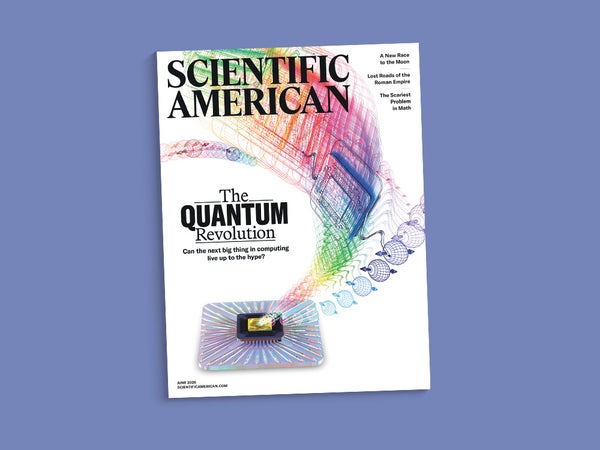
One of the endemic illnesses of the American tech industry is an addiction to unsupported superlatives: Descriptors like “revolutionary,” “game-changing” or “disruptive” are applied to inventions that are at best incremental and at worst of no use at all.
Despite the fact that I know this to be true, I now offer the following extraordinary statements: Quantum computing could change the world. It’s transformative, monumental, unprecedented. A once-in-a-generation technology that shifts paradigms and ushers in a new era of innovation. A quantum leap, even.
Here’s one example why: Modern finance—our entire economic system, really—relies on public-key cryptosystems that are essentially unbreakable. Even the consumer-level codes that encrypt your online banking are so hard to break that every computer on the planet working together would need longer than the age of the universe to brute-force them apart.
On supporting science journalism
If you're enjoying this article, consider supporting our award-winning journalism by subscribing. By purchasing a subscription you are helping to ensure the future of impactful stories about the discoveries and ideas shaping our world today.
A quantum computer could factor those integers and steal your mortgage payment in just a couple of hours.
Of course, there’s a catch, and it’s a big one. Despite huge advances in the field, we don’t actually know how to build a functionally useful quantum computer or even if such a thing is possible at all. In this month’s cover story, science journalist and astrophysicist Adam Becker takes us inside the cryogenically chilled heart of quantum computing to find an answer: Will quantum computers transform medicine, materials science and cybersecurity, or is the tech industry betting billions on a sci-fi fantasy?
Elsewhere in the issue, Scientific American staff reporter Joseph Howlett seeks answers to another as yet unsolved problem that could reshape everything from cryptography to physics: the Riemann hypothesis, a 167-year-old conjecture so difficult to prove that top mathematicians avoid even trying. “The Scariest Problem in Math” has a million-dollar reward for its solution, but Howlett explains why hardly anyone is trying to find it.
We also take time to reflect on a recently completed achievement that has impressed and inspired us all. Over 11 days in April, the Artemis II moon mission took humans back to the moon and farther from Earth than they had ever been before.
Journalist Nadia Drake explains how the triumphant expedition marks a new era of lunar exploration, while our own Joe Howlett explains why Artemis’s future will be a game changer for astronomy. In “A Nuclear Moon,” volcanologist and science writer Robin George Andrews digs into why NASA wants to build a fission reactor on the lunar surface within the next five years and why that plan isn’t as crazy as it sounds.
Finally, after all that looking forward to the future, we invite you to take a nice stroll down the roads of our ancient past. Archaeologist Tom Brughmans takes readers on a journey through a digital mapping project that is transforming what we know about the Roman Empire by combining centuries-old archaeological records with satellite imagery and modern topographic data. Brughmans and his team have assembled the first high-resolution digital map of Roman roads that shows the network might have stretched some 300,000 kilometers, carrying troops, grain, ideas and disease across an area rivaling the modern European Union.
So, yes, superlatives like “revolutionary” and “game-changing” do get thrown around too easily. But as this issue shows, science can make our world turn upside down, whether because of a qubit, a conjecture, a moonshot or a map of 2,000-year-old roads. Hyperbole isn’t always hype; sometimes the truth catches up.