
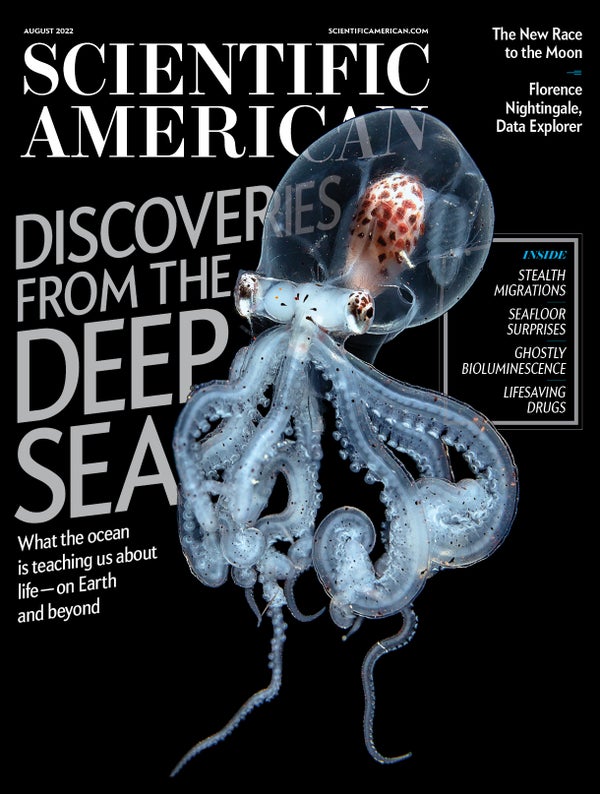
We humans may think of ourselves, or possibly beetles, as typical Earthlings, but to a first approximation, life on Earth exists in the sea. And what spectacular life! Our special package on the oceans is teeming with images of eerie, delicate, elaborate, glowing and occasionally kind of frightening creatures that have rarely been seen by terrestrial species. The in-depth report was guided by sustainability senior editor Mark Fischetti along three main themes: mystery, discovery and surprise.
One of the most common abilities on Earth is a mystery we're just now solving: bioluminescence. As author Michelle Nijhuis shares, recent surveys show that most organisms in the ocean are able to glow. This ability evolved independently across phyla, using different chemical processes and for different purposes, transmitting light-based messages even on the seafloor.
Ocean creatures live much more three-dimensional lives than people realized, surging vast distances from the deep ocean toward the surface in search of food. This “diel migration”—by an estimated 10 billion tons of animals—moves carbon and other elements through the oceans and the world, as contributing editor Katherine Harmon Courage explains. The stunning images for this story and throughout the package were gathered by photography editor Monica Bradley.
On supporting science journalism
If you're enjoying this article, consider supporting our award-winning journalism by subscribing. By purchasing a subscription you are helping to ensure the future of impactful stories about the discoveries and ideas shaping our world today.
Sea-dwelling creatures are exposed to a lot of pathogens, and they have evolved an astonishing variety of chemical defenses to protect themselves. These chemicals have the potential to treat human diseases, and as science journalist Stephanie Stone reports, some have been turned into treatments for various types of cancer, chronic pain and COVID, with many more deep-sea drugs in development.
The textbook view of the oceans stratifies them into layers according to depth. As Fischetti describes, that's just one way to slice it. Scientists are increasingly realizing that other qualities are just as important for understanding ocean zones: salinity, light, color, temperature, even life-forms. The eye-opening graphics by Skye Moret and Scientific American senior graphics editor Jen Christiansen offer a new inspiring view of the ocean.
Mystery, discovery and surprise. As deep-ocean biologist Timothy Shank writes, the ocean is full of diverse life, unexpected chemistry and weird physics—and there's still so much to learn.
You may have heard that we know more about the surface of the moon than the structure of the seafloor, but as Fischetti details, with new marine mapping and the release of private data, that soon won't be true (if it ever was).
What's next for the moon? There's a race among nations and various billionaires to send missions, and possibly people again, to the moon, which is a lot more difficult than sending a rocket to space. Author Rebecca Boyle reports that scientists are cautiously optimistic—there's a lot of research to be done on the moon, and new partnerships with private companies could actually lead to an exciting time of lunar exploration.
Clear, dramatic graphics have the power to change the world. Florence Nightingale launched the modern era of public health and public health messaging with her depictions of death and disease during the 1853–1856 Crimean War. They helped to revolutionize medical practices around the world and saved countless lives. Our graphics editors at Scientific American are always striving to present complex, mind-bending and sometimes invisible phenomena using engaging graphics, building on Nightingale's work.