
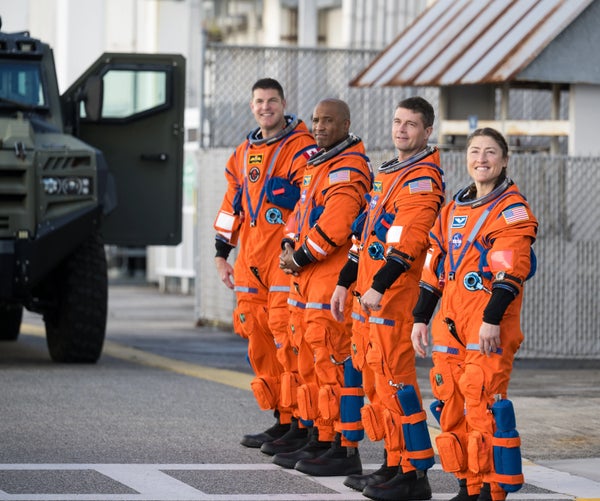
NASA astronauts and officials presented a united front Sunday: despite numerous delays, problems with the rocket and worries over the astronauts’ safety, they are confident that NASA is going to launch a crew around the moon as soon as this week. If the launch takes place, it will mark the first time that humans have left Earth orbit for more than fifty years—since Apollo 17 in 1972.
NASA is currently targeting April 1 to launch the Space Launch System that will send the Orion crew capsule to the moon. Already delayed, the mission has been postponed multiple times this year because of problems with the spacecraft that arose during testing. NASA has picked other possible dates in April and later this year if the launch has to be put on ice again.
Acting associate administrator for NASA’s Exploration Systems Development Mission Directorate Lori Glaze said at a press conference Sunday that everything pointed toward the mission being ready to go. Shawn Quinn, who is NASA’s manager for Exploration Ground Systems, said the weather forecast currently seems 80 percent in favor of a launch this week.
On supporting science journalism
If you're enjoying this article, consider supporting our award-winning journalism by subscribing. By purchasing a subscription you are helping to ensure the future of impactful stories about the discoveries and ideas shaping our world today.
“We can safely say the crew is ready, the rocket is ready, the spaceship is ready, Ground Systems are ready, and we only need to have the weather to cooperate,” Quinn said.
The upcoming mission, Artemis II, will see the crew of four astronauts—Reid Wiseman, Christina Koch, Victor Glover and Jeremy Hansen—potentially go further out into space than any other human has gone before. The 10-day mission will also test the rocket and crew capsule’s capabilities, enable observations of the more mysterious far side of the moon and a slew of other medical and science experiments.
“The team is ready to go, and the vehicle is ready to go,” Wiseman, the mission captain, said at a separate crew-only press conference on Sunday. He and the rest of the crew arrived in Florida on Friday—they entered quarantine on March 18, a necessary step that helps to protect the crew from any would-be hitchhiking germs. But, he said, the crew is prepared for further delays if needed. “Not for one second do we have an expectation that we are going. We will go when this vehicle tells us it’s ready and when the team is ready to go.”
The flight is designed to test out much of the technology that will be used in later moon missions, such as the planned Artemis III and Artemis IV missions and beyond‚ as well as informing the agency’s future plans for a permanent human settlement on the moon. One of the major ambitions of the mission is to observe more of the far side of the moon; while satellites have imaged the moon’s far side and some Apollo-era missions did observe parts of it, the Artemis II crew will likely see features on the lunar surface no human has seen before.
Wiseman said at the crew’s press conference that the crew was prepared for the potential risks the flight might pose. “At the end of the day, every ship needs a captain, and I’m ready to make those decisions, but I’m not making them in a vacuum,” he said at the same press conference.
“We’re going to go slow, and we have the ultimate trust in each other. And that’s how we will get through this.”
Editor’s Note (3/29/26): This article was changed after posting to correct the attribution of two quotes.