New Issue: Science’s Impossible Questions. Read Now

NASA’s Artemis II astronauts arrive in Florida ahead of moon launch

During their 10-day mission, this four-person crew will swing around the far side of the moon—and potentially travel farther from Earth than anyone in history

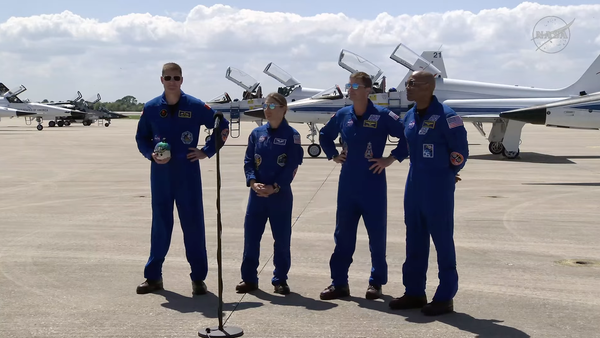
Four people standing in blue flight suits arrayed behind a microphone.

Canadian Space Agency astronaut Jeremy Hansen and NASA astronauts Christina Koch, Reid Wiseman and Victor Glover speak with press after arriving at NASA’s Kennedy Space Center in Florida on March 27 in preparation for the Artemis II mission.

NASA TV

NASA has launched four astronauts on a pioneering journey around the moon—the Artemis II mission. Follow our coverage here.

Join Our Community of Science Lovers!

Before they set off on a historic flight to the moon next week, the four astronauts of the Artemis II crew had to make one final terrestrial commute—to Florida.

NASA astronauts Reid Wiseman, Victor Glover, and Christina Koch and Canadian Space Agency astronaut Jeremy Hansen arrived at NASA’s Kennedy Space Center on March 27, five days before their scheduled April 1 liftoff. The astronauts flew themselves from Houston, which houses NASA’s Johnson Space Center, in two T-38 training jets and then disembarked to speak with reporters.

The 10-day mission will mark the first time humans have left Earth orbit since the Apollo 17 mission ended in 1972. Depending on the precise trajectory their spacecraft takes, the Artemis II crew may travel farther from Earth than any humans to date.


On supporting science journalism

If you're enjoying this article, consider supporting our award-winning journalism by subscribing. By purchasing a subscription you are helping to ensure the future of impactful stories about the discoveries and ideas shaping our world today.


“Hey, let’s go to the moon!” said Wiseman, the mission commander, to open the crew’s remarks. “I think the nation and the world has been waiting a long time to do this again.”

“I am fired up,” Hansen added. “We’re all fired up to go do this.”

Artemis II is due to blast off from Kennedy’s Launch Complex 39B at 6:24 P.M. EDT on April 1. If the mission is scrubbed during the initial two-hour window, additional launch opportunities will continue through April 6.

The crew has been in medical quarantine since March 18 to protect their voyage from hitchhiking germs. Although the astronauts previously isolated for target launch dates in February and March that were ultimately delayed, this represents the first attempt that has seen the crew land in Florida.

Wiseman acknowledged that even with several upcoming opportunities, his feet may stay on the ground for weeks or even months to come. “We are ready for that,” he said. “A little piece of my brain is always holding on that April 1 is not a guarantee, April 6 is not a guarantee.”

Glover concurred. “It’ll go when the engines light at T-zero; we totally understand that.”

Despite the looming uncertainties of rocket science, the crew remains focused. Koch shared how moved she was that, during the flight over, an air traffic controller wished her and the crew luck on the launch. “We’re ready to do this and fulfill our mission for all of you,” she said.

Editor’s Note (3/27/26): This is a developing story and may be updated.

Meghan Bartels is a science journalist based in New York City. She was previously a senior reporter at Scientific American. Before that she spent more than four years as a writer and editor at Space.com, as well as nearly a year as a science reporter at Newsweek, where she focused on space and Earth science. Her writing has also appeared in Audubon, Nautilus, Astronomy and Smithsonian, among other publications. She attended Georgetown University and earned a master’s degree in journalism at New York University’s Science, Health and Environmental Reporting Program.

More by Meghan Bartels

Subscribe to Support Independent Journalism

Great science journalism requires human expertise, time, effort and creativity. And it costs money. That’s why I and the journalists here at Scientific American hope you’ll join our community.

When you subscribe, you are supporting staff and freelance journalists who are passionate about telling science stories that are true, important and compelling. Our editors and reporters are often experts in their fields, which means they understand the nuances of big discoveries and can untangle the breakthroughs from the hype. With a subscription, you are also supporting rigorous fact-checking to ensure the words we publish are precise and accurate. And you’re supporting original illustrations, graphics and photos that bring you closer to an advanced laboratory, an ice sheet in Antarctica or a space mission in orbit. You’re helping us craft other types of high-quality journalism as well: Our newsletters are carefully written, edited and curated by staffers you have or will come to know and love. Our Science Quickly podcast is based on original reporting, collaboration with editors and scientists and exacting production.

Subscriptions keep this engine running so we can continue to deliver thoughtful, rigorous and independent science journalism to you. In an era of viral misinformation, this work is crucial. If you value what we do, I hope you’ll consider joining us as a subscriber

Thank you,

Jeanna Bryner, Editor in Chief, Scientific American

Subscribe