
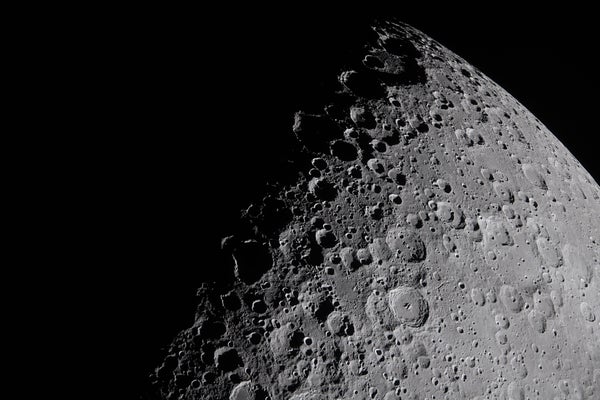
On its sixth day, NASA’s Artemis II mission at last delivered what it had promised.
Its four astronauts—NASA’s Reid Wiseman, Victor Glover, and Christina Koch and the Canadian Space Agency’s Jeremy Hansen—successfully traveled around the moon, returning humans to the lunar vicinity for the first time in more than a half-century. In the process, they became the farthest people yet flown from Earth, experienced an in-space solar eclipse, captured “Earthset” and “Earthrise” images of our planet and saw features of the moon's far side that no one had seen before.
After the observations were done, they heard from President Donald Trump—NASA’s Artemis program began under his first term.
On supporting science journalism
If you're enjoying this article, consider supporting our award-winning journalism by subscribing. By purchasing a subscription you are helping to ensure the future of impactful stories about the discoveries and ideas shaping our world today.
“You know, I had a decision to make in my first term, and the decision is ‘What are we going to do at NASA?’” the President told the crew after congratulating them during a call on Monday. “Are [we] going to have it be revived, or are we going to close it down? We’ve spent what we had to do.”
The call came just days after the release of the White House’s latest federal year 2027 budget proposal, which has called for cutting NASA’s funding by 23 percent and slashing the space agency’s science budget by 47 percent. Adjusted for inflation, if passed into law, Trump’s proposal would give NASA its smallest budget since 1961.
The conversation faltered after the president favorably compared crew member Hansen to famed Canadian hockey player Wayne Gretzky. The astronauts laughed and clapped before becoming visibly uncertain, as no response came from the ground for a full minute. Wiseman asked for “a quick comm check,” to which Trump immediately replied that he was still on the line, concluding the call shortly thereafter.
Yet speaking to the U.S. president was, in some respects, among the least remarkable things the crew had done that day.
The excitement began around 2 P.M. EDT, when they officially became the farthest humans from Earth in history, surpassing a record set in 1970 by the astronauts of Apollo 13.
“We most importantly choose this moment to challenge this generation and the next, to make sure this record is not long lived,” Hansen said as the milestone passed.
They’d spent years preparing for this moment, a fleeting window of time to gaze upon and document the moon. Soaring some 4,067 miles above the surface at closest approach, the astronauts saw the moon as no one has before.
The Artemis II crew took turns across several hours photographing and narrating what they saw to Houston Ground Control—and to the audience watching their livestreamed progress. Limits on deep-space communications meant their snapshots weren’t immediately available, leaving the crew grasping for words to describe what they were seeing: a ridge like a “healing wound” on the lunar skin, bright craters like “a lampshade with tiny pinprick holes,” streaks of frozen lava as smooth as a “paved road.”
“It was hard to speak, looking through the zoom,” Glover said at one point. “I was walking around down there on the surface, climbing and off-roading on that amazing terrain.”
Fortunately, the crew had been trained to lock in and make sense of the dazzling display of color and light at play through Orion’s windows.
How bright or dark a given feature is—its color on the white-black spectrum, or its “albedo”—is a mixture of its topography, illumination and reflectivity. So a spot might appear dark because it’s recessed or because of a shadow cast by a neighboring ridge or because it has a mineral makeup that glimmers differently than mere moon dust. Armed with flash cards and intensive training, the astronauts identified known features and puzzled over new ones as best they could.
At 6:44 P.M. the Orion spacecraft slipped behind the moon, beginning a preplanned 40-minute communications blackout with mission control. “We’re still going to feel your love from Earth,” Glover said just before contact was lost. “We will see you on the other side.” The crew reemerged into line-of-sight communications with Earth at 7:24 P.M. and viewed our world as a small teal crescent set against the darkness of deep space. This was the first “Earthrise” witnessed by astronauts since the final mission of the Apollo program in 1972, and it displayed parts of Africa, Asia and Oceania to the Artemis II crew.
An hour later (after more observations), the astronauts saw yet another stunning spectacle when the sun passed behind the moon from their perspective. The total solar eclipse lasted about an hour. During the eclipse, the crew counted several flashes from micrometeoroid impacts on the lunar surface and marveled to see the moon’s face lit with a dim bluish glow—it was earthshine, the reflected light of our world’s oceans, clouds and continents.
“No matter how long we look at this, our brains are not processing this image in front of us,” Wiseman said. “It is absolutely spectacular, surreal. There’s no adjectives.”
At 9:24 P.M. fiery tendrils of the sun’s wavering corona—described as “baby hair”—began to sprout from the edge of the moon, signaling the sun’s imminent return and the eclipse’s final moments. “That baby hair is rapidly growing out toward the nine o’clock,” Glover said. “If you’ve ever seen the spotlight off the top of the Luxor at night in Las Vegas, this looks like what that wants to be when it grows up.”
After their call with Trump, the crew began their presleep routine, preparing for the long journey home. Orion’s flyby of the moon had curved the spacecraft’s trajectory back toward Earth, where, if all goes well, the crew should splash down in the Pacific Ocean off San Diego, Calif., shortly after 8 P.M. on April 10. At 1:25 P.M. on April 7, the mission’s seventh day in space, Orion will leave the moon’s sphere of influence, slipping back into Earth’s gravitational dominion.
The crew is also set to speak with scientists about their lunar observations on Tuesday. And later that day they will take another long-distance call from astronauts onboard the International Space Station.
Otherwise, the crew will spend most of their seventh day in space off duty, resting for their final homecoming—and no doubt reminiscing about their fleeting encounter with the moon.