See How the Wildfire Smoke Spread Across the U.S.

Most of the eastern U.S. has been swathed in smoke billowing off more than 400 wildfires across Canada

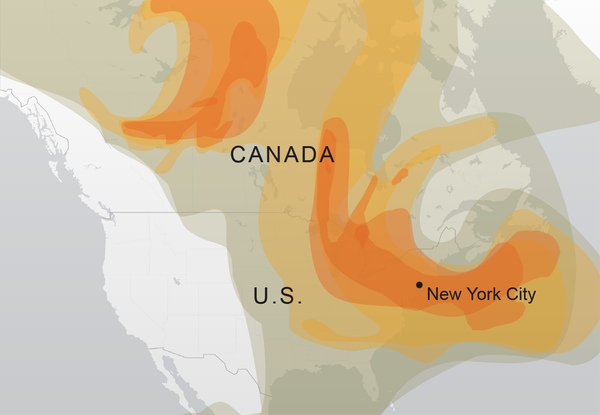
Map overlaid with swathes of color indicates large areas of smoke over North America.

Ripley Cleghorn

Join Our Community of Science Lovers!

Much of the eastern U.S. has seen unsettlingly hazy skies this week as smoke from the more than 400 wildfires currently blazing across Canada has blown south.

Wednesday was by far the worst day for wildfire smoke in the contiguous U.S. since 2006, according to researchers at Stanford University’s Environmental Change and Human Outcomes Lab, and Tuesday claimed the number four slot. Scientists are still waiting to see how Thursday compares.

Although wildfire smoke is a common hazard in the western U.S., it’s rare on the East Coast. Millions of people in newly affected region scrambled to understand the official Air Quality Index, which quantifies just how dangerous the air is, and to protect themselves from the acrid smoke particles.


On supporting science journalism

If you're enjoying this article, consider supporting our award-winning journalism by subscribing. By purchasing a subscription you are helping to ensure the future of impactful stories about the discoveries and ideas shaping our world today.


To visualize the spread of smoke, consider this map, which shows data from Wednesday. One particularly concentrated plume of smoke arcs southward from fires burning in and around Quebec, covers the Great Lakes and then sweeps over New York City and out above the Atlantic Ocean.
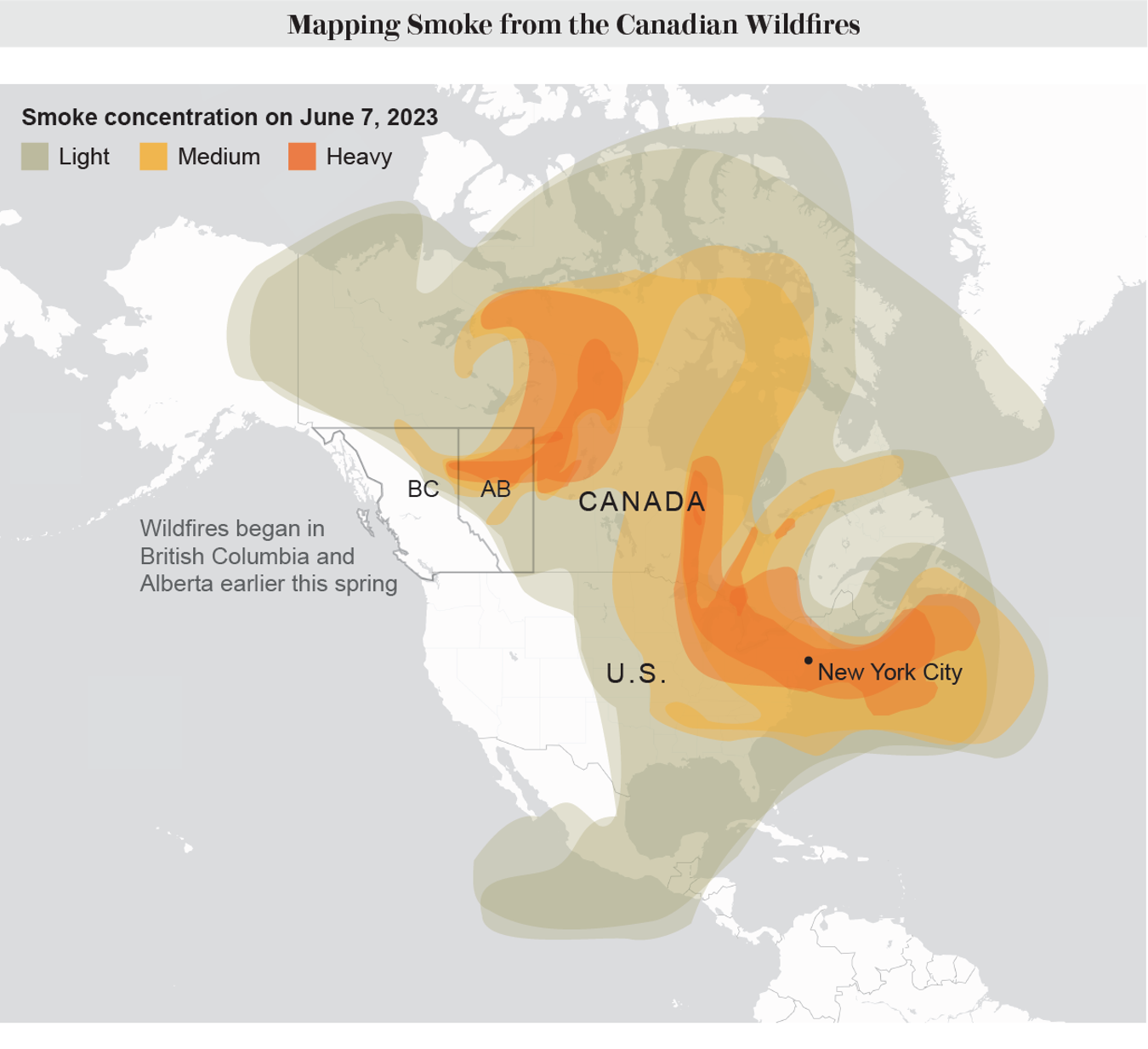
But while the worst conditions are in the eastern U.S., lower concentrations of smoke coat much of the nation, as well as nearly all of Canada and a portion of Central America. Even states as far from the fires as Tennessee saw serious amounts of smoke in the atmosphere.

The map is based on smoke detected in photographs taken by the satellites GOES-East and GOES-West, which are both operated by the National Oceanic and Atmospheric Administration.

Meghan Bartels is a science journalist based in New York City. She joined Scientific American in 2023 and is now a senior reporter there. Previously, she spent more than four years as a writer and editor at Space.com, as well as nearly a year as a science reporter at Newsweek, where she focused on space and Earth science. Her writing has also appeared in Audubon, Nautilus, Astronomy and Smithsonian, among other publications. She attended Georgetown University and earned a master’s degree in journalism at New York University’s Science, Health and Environmental Reporting Program.

More by Meghan Bartels

Ripley Cleghorn is a science communicator and data visualization designer. She is Scientific American’s current graphics intern.

More by Ripley Cleghorn

It’s Time to Stand Up for Science

If you enjoyed this article, I’d like to ask for your support. Scientific American has served as an advocate for science and industry for 180 years, and right now may be the most critical moment in that two-century history.

I’ve been a Scientific American subscriber since I was 12 years old, and it helped shape the way I look at the world. SciAm always educates and delights me, and inspires a sense of awe for our vast, beautiful universe. I hope it does that for you, too.

If you subscribe to Scientific American, you help ensure that our coverage is centered on meaningful research and discovery; that we have the resources to report on the decisions that threaten labs across the U.S.; and that we support both budding and working scientists at a time when the value of science itself too often goes unrecognized.

In return, you get essential news, captivating podcasts, brilliant infographics, can't-miss newsletters, must-watch videos, challenging games, and the science world's best writing and reporting. You can even gift someone a subscription.

There has never been a more important time for us to stand up and show why science matters. I hope you’ll support us in that mission.

Thank you,

David M. Ewalt, Editor in Chief, Scientific American

Subscribe