
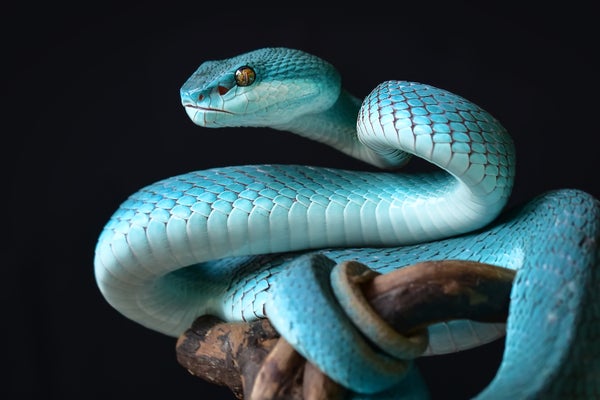
As the new moon rises this week, it ushers in a new year on the lunar calendar used by many cultures across East and Southeast Asia. On the Chinese zodiac’s 12-year lunar cycle, 2025 is the Year of the Snake—an animal that symbolizes wisdom and change.
These limbless reptiles can be found on every populated continent, thanks to an evolutionary “big bang” some 125 million years ago. There are more than 3,000 snake species, with incredible variation among them. Some of the animals are smaller than an earthworm, while others are longer than a pickup truck. Some are harmless to humans, whereas others are venomous. And the ecological roles they play as critical pest controllers and nutrient cyclers are often underappreciated. So as we look to the year ahead, let’s give our odd, wriggly friends some appreciation.
On supporting science journalism
If you're enjoying this article, consider supporting our award-winning journalism by subscribing. By purchasing a subscription you are helping to ensure the future of impactful stories about the discoveries and ideas shaping our world today.
Shimmying Serpents
Snakes’ signature move is the slither. But they can also scrunch forward like an inchworm or launch themselves from a coiled position to leap or strike. And a few years ago scientists discovered another, stranger method of snake movement: “lasso locomotion.” Researchers were testing ways to keep brown tree snakes away from birds’ nests in Guam. They put wide metal cylinders at the bottom of poles, expecting this to deter the snakes, which generally need to wrap themselves twice around a pole or tree trunk to climb it with their normal, accordionlike “concertina locomotion.”
Instead the team found that snakes were literally tying themselves into knots to surpass the barriers. The reptiles would wrap their tail just once around the barrier and then hook the tip around their body. This created a sort of lasso shape that the snakes could use to shimmy up the pole—ever so slowly but effectively.
Thermal Vision
Pythons, boas, pit vipers, and more can hunt in total darkness. They sense prey animals not only by smell but also by the heat their quarry emanates. These snake’s so-called pit organs enable them to “see” this heat; the organs act like a thermal camera that allows the reptiles to home in on a target.
Pit organs are membrane-covered divots near a snake’s nostrils. Infrared radiation emanating from potential prey heats up the membrane, which causes it to thicken and changes the small electric charge that runs across the membrane’s outer surface. That voltage change gets passed to nerve cells, which send the information to the brain.
Open Wide
Snakes generally don’t chew their food. Instead they swallow prey whole and slowly digest it over the course of days. Burmese pythons, for example, can spend an entire week digesting a single meal. While they normally eat smaller mammals like rodents, these pythons have also been spotted consuming comparatively enormous alligators and deer. They can open their mouth four times wider than their skull.
This impressive feat comes down to some stretchy skin and tissue. Contrary to popular belief, snakes don’t unhinge their jaws to consume big prey. Their lower jaw is actually made of two unfused halves that are connected by stretchy tissue, a design that allows them to flare the halves of their lower jawbone out to the sides. Burmese pythons can open up particularly wide because of the extra-flexible tissue in their jaw.
Venom Grooves
There are more than 3,000 species of snakes, and more than 600 of them are venomous. These snakes’ fangs are shaped with chilling efficiency to deliver the maximum venom load into their prey. This adaptation evolved multiple times, each time starting with the ridges that anchor snakes’ teeth to their jaws. In venomous snakes, these ridges grew longer, eventually becoming a groove that allows venom to flow from the gland to the tip of the fang—and right into the prey.
Dual Anatomy
Snakes’ external reproductive organs come in pairs. Males have two penises, and females have two clitorises. In females, these organs had long been mistaken for scent glands.
Technically called hemipenes, the male organs are usually held inside the body and turned inside out—except during copulation, when the hemipenes are everted outside the body. In some snake species, the dual penises are covered in spikes or hooks.
Prehistoric Giants
Today’s longest snake species is the reticulated python, which usually reaches 13 to 16 feet long. In rare cases, they can top 20 or even 30 feet.
But these would seem puny compared with some of the snake species that slithered on Earth millions of years ago. Last year researchers published their discovery of Vasuki indicus, a snake from 47 million years ago that stretched to an estimated 36 to 49 feet. The fossilized remains of 27 vertebrae had been discovered 20 years prior in a coal mine in Gujarat, India. Researchers had initially assumed these bones came from a prehistoric crocodile species.
The length estimates for Vasuki indicus, named after the serpent king Vasuki of Hindu folklore, would put it on par with Titanoboa cerrejonensis, another titan from 60 million years ago, whose fossilized remains were discovered in Colombia.
Python Invasion
A few years ago Florida made it illegal to keep a Burmese python as a pet. That’s because these snakes have become an invasive scourge in the Everglades, where they have severely reduced the populations of many local species of mammals. The state’s population of these pythons, which are native to Southeast Asia, descended from escaped or released pets. In 1992, for example, Hurricane Andrew destroyed a python breeding center and resulted in many of the snakes getting out into the wild. For the past decade, the Florida Fish and Wildlife Service has held an annual competition called the Florida Python Challenge. Last year’s winner captured 20 of the reptiles and a $10,000 prize.
These giant snakes, which are usually between six and nine feet long, can be very difficult to find despite their growing numbers. On Key Largo, they hide in the natural pores of the Swiss-cheese-like local bedrock. Researchers once found a 12-foot python by following the GPS collar of an opossum they had been studying—which had become the snake’s dinner.
Though the Everglades are now solidly python territory, there’s more hope for the Florida Keys farther south. “We’re still relatively early in the invasion front” on the Keys, says Michael Cove, a conservation ecologist for the opossum project and a research curator of mammalogy at the North Carolina Museum of Natural Sciences. “There is still the potential for management before it’s too late.”