
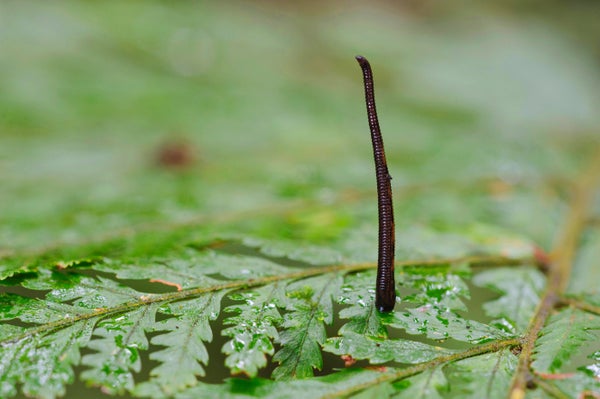
Bloodsucking land leeches are tiny but tenacious creatures: they can use their suckers to crawl in search of prey and perhaps can even fall on their targets from trees. But scientists have long debated whether they have an even more unsettling ability: jumping. During a visit to what is now Sri Lanka in the 14th century, explorer and scholar Ibn Battuta wrote of “the flying leech.” In the 19th century naturalist Ernst Haeckel wrote, “Not only do [leeches] creep along the ground seeking what they may devour..., nay, they can even spring to reach their victim.”
Still, some leech specialists remained skeptical. Authors of a 1968 study wrote, “In spite of folk tales to the contrary, land leeches do not jump from vegetation onto their prey.”
Now two researchers have solved this long-standing mystery by collecting the first concrete evidence of jumping leeches. Their observations, published on June 20 in Biotropica, show one species of leech in Madagascar winding up its ropelike body and launching itself into the air like a striking snake.
On supporting science journalism
If you're enjoying this article, consider supporting our award-winning journalism by subscribing. By purchasing a subscription you are helping to ensure the future of impactful stories about the discoveries and ideas shaping our world today.
Back in 2017 Mai Fahmy, now a postdoctoral researcher at Fordham University, was in Madagascar searching for leeches to study for her Ph.D. dissertation. “One afternoon, while collecting leeches, I decided I would spend a moment observing them first,” she says. So, surrounded by an old-growth rainforest, she sat beside a leech that was on a leaf and began recording the scene when something strange happened. “Within seconds, it had jumped twice,” Fahmy says—arching its body and springing from the leaf.
“I assumed this behavior was well documented,” she says. “When I returned to the U.S. and showed [it to] my colleagues, I quickly realized this wasn’t the case.”
When Fahmy visited Madagascar again in 2023, she sought out more evidence. “I didn’t have to wait longer than a couple minutes for the leeches to launch themselves,” Fahmy says. “I couldn’t believe my eyes when I captured the second video.”
After recording and collecting a jumping leech, the researchers found that it belonged to Chtonobdella fallax, a species of land leech with sister species spread across the Indo-Pacific region. They seem to jump how cobras and other striking snakes often attack their prey: the leeches coil their body backward and then extend forward in a purposeful jump. The movement “is intentional, energetic and consistent in the way it coils back and jumps forward,” says Michael Tessler, a biologist at Medgar Evers College, City University of New York, and a co-author of the study.
The researchers speculate the animals may have evolved this ability to get quickly from an elevated place to the ground or to jump directly onto their hosts, including humans. “In terms of evolution, anything that makes a terrestrial leech get blood faster or more stealthily is of great selective advantage,” Tessler says. Future careful observations could determine whether other leech species can jump as well.
The evidence that the leeches in the study are jumping is “solid enough,” says Joachim Langeneck, zoologist at Italy’s National Interuniversity Consortium for Marine Sciences (CoNISMa), who was not involved in the study. “This answer [to the debate] opens up to further, more interesting questions, such as why leeches jump and how are they able to.”