
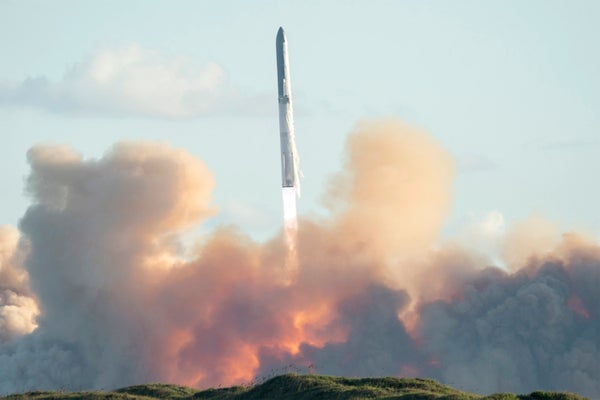
Elon Musk’s SpaceX is gearing up for what could be the most critical test of its Starship megarocket to date as the company comes under the scrutiny of federal officials who are worried that delays to the Starship program will eat into NASA’s planned moon mission timeline and affect worker safety at SpaceX’s Starbase complex in Texas.
The test flight was originally planned for last Friday—the same day that emergency services responded to the death of a SpaceX worker at Starbase. The Occupational Safety and Health Administration has opened an investigation into the incident; the Wall Street Journal reported the person was a contractor at Starbase who died in a fall, while social media posts indicated emergency vehicles outside the Gigabay building—a facility SpaceX uses to produce and maintain Starship. It is not clear whether the delay in the upcoming Starship launch’s timing is at all related to this incident; SpaceX did not immediately respond to a request for comment.
SpaceX had initially punted the launch date to May 19 before the company announced a further delay over the weekend. Now it is targeting May 21, with a launch window opening no earlier than 6:30 P.M. EDT. SpaceX will livestream the launch on its website and YouTube.
On supporting science journalism
If you're enjoying this article, consider supporting our award-winning journalism by subscribing. By purchasing a subscription you are helping to ensure the future of impactful stories about the discoveries and ideas shaping our world today.
Starship is currently one of two proposed vehicles that NASA wants to use to ferry its astronauts from lunar orbit to the moon’s surface as soon as 2028. The space agency is also angling to test Starship’s ability to rendezvous and dock with its own crew capsule, Orion, in Earth orbit in 2027. But a federal watchdog report published in 2025 warned that Starship is seriously behind schedule—SpaceX has yet to show that it can safely and successfully get astronauts back to the moon.
This test flight, SpaceX’s 12th overall, marks the first for Starship V3—the latest and largest version of the vehicle, standing some 407 feet (124 meters) tall when fully stacked. It’s designed to loft more than 100 metric tons of cargo to orbit and to be fully reusable, but SpaceX hasn’t demonstrated that the vehicle is ready for orbit. This test will also be suborbital and is aimed at showing the new hardware works as expected; most previous Starship tests have ended in an explosion or with the disintegration of the rocket, although the most recent two tests were successful.
The outcome of Thursday’s scheduled demonstration could also set the tone for SpaceX’s highly anticipated initial public offering (IPO), which, with a likely valuation of $1.75 trillion, would make it the biggest IPO ever. SpaceX has touted Starship as a workhorse vehicle that can help boost its commercial rocket launch business and grow its own Internet satellite megaconstellation, Starlink, as well as its planned space-based data center network.