
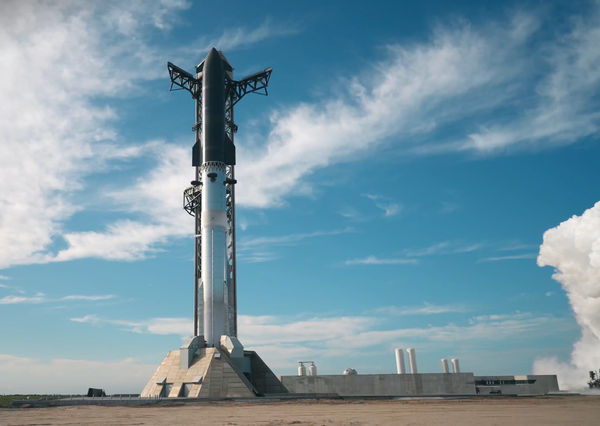
On Thursday SpaceX scrubbed the planned launch of the latest and largest version of its Starship megarocket—the tallest and most powerful rocket ever built. The launch is due to be the 12th flight test of Starship and the first demonstration of its V3 design. The company said a second attempt could come as soon as Friday.
“For those who think this is simply another repeat test flight, the engineering changes under the rocket ‘hood’ are substantial,” said Joseph Gonzalez, an associate professor of practice in aerospace engineering at the University of Illinois Urbana-Champaign and a former engineer for NASA’s Artemis program, to Scientific American before the launch attempt. “V3 is taller, exceeds 18 million pounds of total thrust and introduces the new Raptor 3 engines,” he explained.
According to SpaceX’s recent filing with the U.S. Securities and Exchange Commission ahead of its upcoming initial public offering, in 2025 alone, the company spent some $3 billion developing Starship—out of a total of $15 billion.
On supporting science journalism
If you're enjoying this article, consider supporting our award-winning journalism by subscribing. By purchasing a subscription you are helping to ensure the future of impactful stories about the discoveries and ideas shaping our world today.
Fully stacked with SpaceX’s Super Heavy booster, the vehicle stands some 408 feet (124 meters) tall and is designed to loft as much as 100 metric tons of cargo into orbit and to be fully reusable. This test, however, will not attempt to recover the booster or rocket.
The test, which will not enter Earth orbit, aims to show that Starship V3 can successfully launch, separate from its booster and then splash down in the Indian Ocean. Along the way, the spacecraft is set to deploy 20 dummy Starlink Internet satellites, as well as two operational satellites that are designed to scan Starship’s heat shield and beam images back to Earth.
On reentry, the spacecraft is set to perform a series of maneuvers, including a flip, on its way to splash down into the Indian Ocean (the booster, meanwhile, will drop into the Gulf of Mexico).
A successful launch may be critical for SpaceX. Elon Musk’s company is expected to go public in the next month, and a successful test flight of what Musk says will be its most powerful rocket ever will almost certainly buoy investors’ interest in SpaceX—and NASA’s ambitions of using Starship to get astronauts back on the moon by 2028. SpaceX eventually hopes to use Starship to launch its anticipated artificial intelligence data center satellites.
“Flights like this continue to push the aerospace industry forward and provide invaluable lessons for the next generation of engineers entering the field,” Gonzalez told Scientific American prior to the test attempt.
Editor’s Note (5/21/26): This is a developing story and may be updated.