

Walk into a bookshop nearly anywhere in the world, and you’re almost certain to find a translation of one of Haruki Murakami’s novels. His first book was published in 1979, while Murakami was running a small Tokyo jazz bar – Peter Cat – following a drama degree at Waseda University. Since then the writer has popularized Japanese literature at an unprecedented scale.
While Murakami certainly heightened international awareness of Japan’s writers, his alma mater has long been a focal point for cultural activity, says Associate Professor Hitomi Yoshio. It has spawned a number of renowned authors and filmmakers, such as Yoko Ogawa, Yoko Tawada, and Hirokazu Kore-eda.
Last year, the university established a new literary resource center with a special dedication to Murakami’s work, the Waseda International House of Literature (The Haruki Murakami Library).

This is one of many of the university’s resources that help anchor the Global Japanese Studies Unit, one of seven units attached to the Waseda Goes Global project, which seeks to develop vibrant international academic networks. The center is also expanding its international collaborations as part of the Waseda Goes Global Plan, funded by the Japanese government’s MEXT Top Global University Project.
Yoshio did her doctorate on Japanese women writers and the publishing culture of the early 20th century at Columbia University in the United States. In the last five years she’s helped found English-language undergraduate and graduate degrees in Global Japanese Studies at Waseda. “Whether you’re digging into archives of classical Japanese literature, or studying the contemporary subculture of Tokyo, it’s the logical place to study Japanese culture,” she explains.
Though Yoshio notes that popular subcultures such as manga and anime are the initial hooks for many students interested in Japan, upon entering the university they get to explore the country’s literature, history, and underlying philosophies more deeply.
Yoshio has been overseeing Waseda’s undergraduate Global Studies in Japanese Cultures Program (JCulP) since its inception in 2017. The annual intake has been divided between Japanese and overseas students, and this mixture is intentional. “The program is not about transmitting knowledge of Japanese culture from the inside to the outside. Sometimes it’s the other way around,” says Yoshio. “It’s about questioning and rethinking established perceptions of Japanese culture from an outside perspective, and producing new interpretations together.”

CULTURAL COLLECTIONS
Designed by architect, Kengo Kuma, with input from Murakami himself, the Waseda International House of Literature’s sweeping shelves are stacked with an eclectic mix of literature in a huge range of languages. Murakami also donated furniture to a space that recreates his study, as well as a grand piano from Peter Cat, his original manuscripts, and book and record collections, all of which can be found in different parts of the library.
The university has long recognized the value of preserving important cultural artifacts. In 1928, it established the Tsubouchi Memorial Theatre Museum dedicated to Shoyo Tsubouchi (1859−1935), a former professor at Waseda, author, playwright, and the first person to translate the complete works of William Shakespeare into Japanese. Housed in an Elizabethan-style building modeled on the Fortune Playhouse in London, with an open stage at its front, the museum possesses more than one million items and showcases exhibits on everything from noh, kabuki, and kyogen theatrical forms to contemporary international plays. Today, the museum is also using the latest imaging technology to digitize materials and artifacts, including kabuki scripts and ukiyo-e woodblock prints, as well as noh masks which have been made into three-dimensional images. Many of these assets have been made accessible to the public.
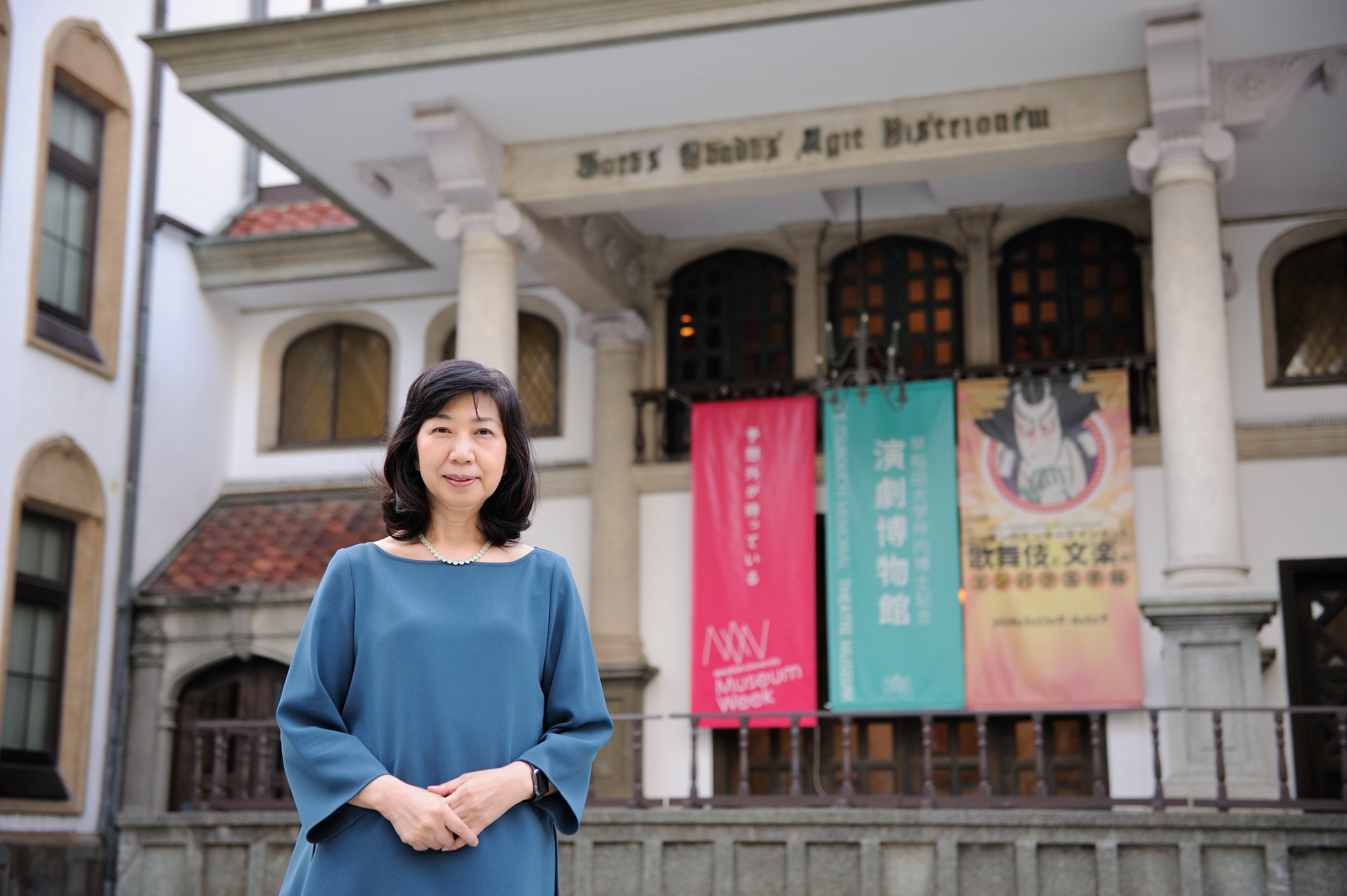
“I think people are hungry for culture because of the COVID-19 pandemic,” comments the museum’s director, Professor Minako Okamuro. She says the pandemic has led to increased online archiving. In 2020, the museum established the Japan Digital Theatre Archives, an informational database and online repository of more than 1,300 Japanese theater performances. The museum also ran a successful exhibition in 2021 called ‘Lost in Pandemic’, which looked at the impact of COVID-19 on the performing arts, showcasing the posters and programs of canceled or postponed performances.
GLOBAL CONVERSATION
“The Tsubouchi Memorial Theatre Museum is dedicated to promoting the richness of Japan’s theater and performing arts to the international community, but it also collects materials from around the world, such as magazines related to French theater and masks used in Indian dances,” explains Okamuro.
“This was part of Tsubouchi’s vision for theater. He emphasized the importance of not just highlighting Japanese theater culture, but also promoting a truly global performing arts culture.”
Through projects like the Haruki Murakami Library and the Tsubouchi Memorial Theatre Museum, Waseda University’s Global Japanese Studies Unit is laying the groundwork to reexamine Japanese culture from a genuinely global perspective. The university’s goal is ultimately to become an international hub to promote scholarly and cultural exchange, and to share its knowledge and resources with the wider world.