


For the 320 million people worldwide who suffer from genetic diseases like cystic fibrosis and hemophilia, effective therapies have been hard to come by. The medicines that are available may treat symptoms and alleviate pain, rather than tackling the root cause of disease.
For these diseases, gene therapies could be transformative. These genetic medicines can replace or repair defective genes, causing the body to produce a missing protein, or stop producing a dysfunctional, damaging protein.
“Gene therapy has the potential to transform the way we treat many diseases, changing the course of a disease rather than managing it,” says Mike McDermott, chief global supply officer and executive vice president at Pfizer, the global pharmaceutical company.
The U.S. Food & Drug Administration (FDA) has already approved five gene therapies that use a virus as a delivery vehicle. As of February 2022, 25 of these viral-vector-based therapies have entered late-stage efficacy testing and another 120 have begun Phase 2 trials to gather safety data, so the number of approved therapies is expected to grow.
But producing these genetic medicines at commercial scale is no simple task.
As manufacturers since Henry Ford have discovered, things are more economical to make when they’re standardized and when production is streamlined. But these traditional manufacturing principles don’t work for makers of gene therapies, which differ from one disease to another, reach smaller patient populations, and may cost millions of dollars per treatment. Instead, gene therapy makers must design facilities that balance the flexibility to make different therapies with the high-volume throughput needed to drive down costs.
What’s needed, McDermott says, is a “transformative approach to manufacturing.”
A long road
To develop a drug, companies have historically screened thousands of small-molecule compounds that can enter cells easily. They choose a handful with the desired effects, then build or revamp a manufacturing plant to mass-produce the best of them for clinical trials and commercial production. The result is a single drug that can treat thousands, sometimes millions, of patients.
Gene therapies, in contrast, consist of a therapeutic gene that’s most often packaged into a virus—specifically, an adeno-associated virus (AAV), a type of virus that can deliver the gene to the body, but does not cause human disease.
To produce an AAV-based gene therapy, scientists first grow human kidney cells in the lab, then add three self-replicating genetic elements called plasmids that together induce the kidney cells to produce an AAV strain containing a therapeutic gene, called a recombinant AAV (rAAV), says Krishna Mallela, a professor at University of Colorado’s Center for Pharmaceutical Biotechnology in the Skaggs School of Pharmacy and Pharmaceutical Sciences, who studies proteins associated with muscular dystrophy and pharmaceutical formulation.
For more than two decades, they have done so at lab-scale volumes—often less than a liter—by carefully adjusting the buffer compounds in the cell culture broth, as well as its temperature, atmosphere, pH and other additives. But the same growing conditions have failed almost universally when producing hundreds or even thousands of liters in large bioreactors for clinical trials, and often the supply of clinical-grade rAAV has often failed to meet the demand, Mallela says. “It has been a struggle to show that we can make them as a drug in a reproducible way.”
The path to the clinic
With conventional drugs, companies rarely change manufacturing processes once they’re set. These processes are governed by rigorous FDA regulations, and reapplying for regulatory approval can be prohibitively expensive and can delay drug development.
In contrast, each gene therapy requires a slightly different manufacturing process. It would be hugely expensive to build an entire plant to make each new gene therapy, so Pfizer has been pursuing advanced methods to flexibly manufacture them, as part of a larger effort to develop a new manufacturing infrastructure and deliver new medicines to market more quickly.
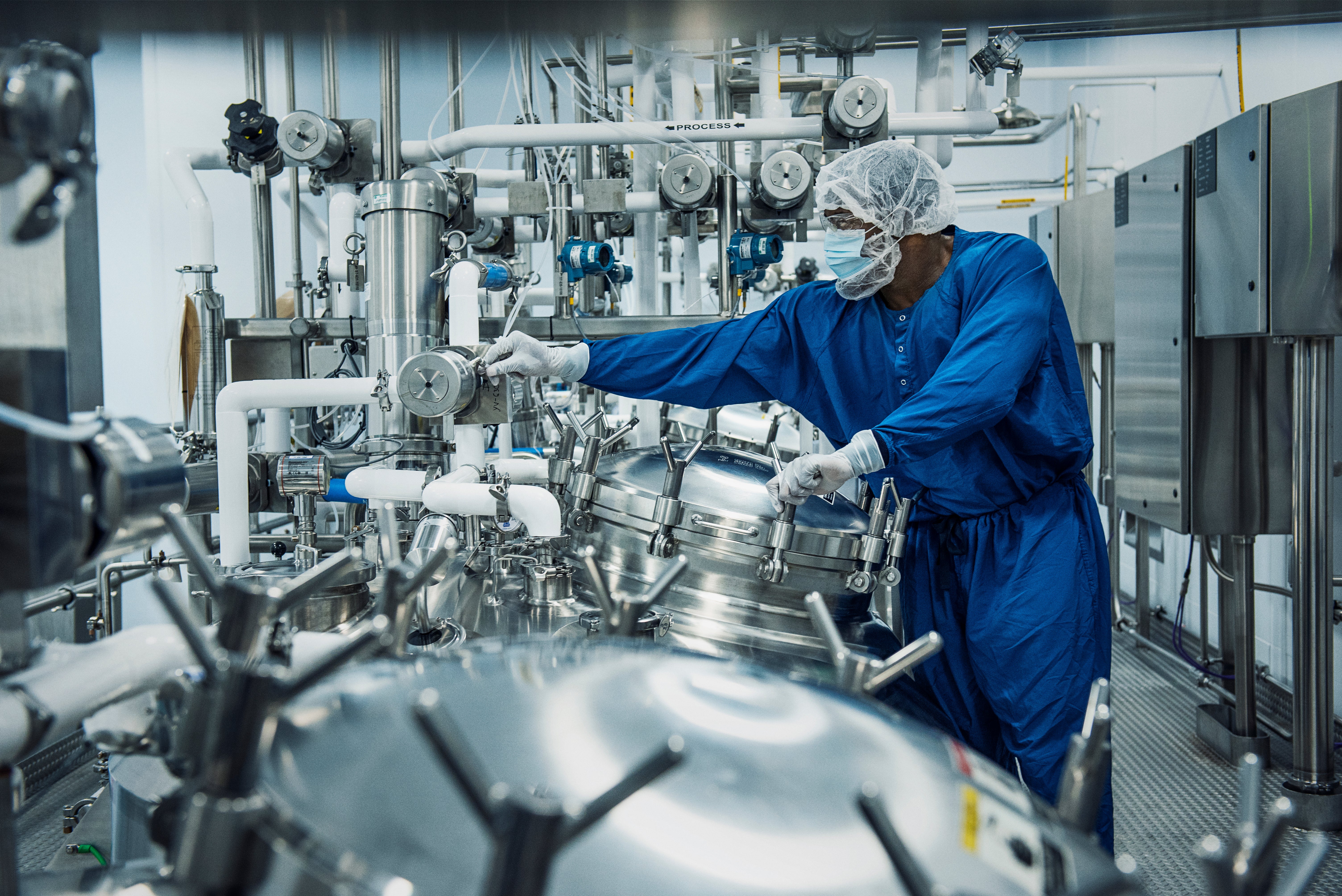
The company has invested $800 million since 2017 in a manufacturing hub near North Carolina’s Research Triangle Park. The hub includes an R&D facility for preclinical testing of new medicines, a nearby pilot plant that produces medicine for late-stage clinical trials, and, just down the road in Sanford, North Carolina, the first manufacturing plant in the world for the commercial production of gene therapies.
For early clinical trials, technicians at the Pfizer pilot plant grow the kidney cells over several weeks in a series of increasingly larger vessels, culminating in a 200-liter bioreactor. But late-stage clinical trials meant scaling up the process to a new 2,000-liter bioreactor, says Jordan Hjelmquist, the primary project manager and drug product operations lead for Pfizer’s Sanford plant.
“We had to understand every aspect of the larger bioreactor, the reactions taking place in it and the downstream processes,” Hjelmquist says. “We were here late nights and weekends. I started to wonder if it would ever get any better.”
The challenges of commercialization
Eventually, Hjelmquist and his team created a robust, consistent process. But scaling to commercial production meant even bigger batches and more challenges, and required more innovation, says Ann Czar, who heads facility operations and compliance at the Sanford facility.
In response, the Pfizer team developed a flexible process. Instead of a dedicated stainless-steel bioreactor that another drug manufacturer might use, it employs single-use bioreactors—large, sterile containers with the tubing, ports and instruments needed to process cells and vectors at each stage of the operation. These are easier to modify to generate a variety of viral vectors in the same facility. Just as important, she adds, “single-use reactors are a lot more flexible than a stainless-steel system for a process we may still need to modify.”
Challenges remain, Hjelmquist says. More automation and improvements in instrumentation should generate the data needed to refine the process from run to run, which should improve yield and output.
Despite the challenges, the work remains rich and fulfilling, Hjelmquist says. “It’s one thing to say, ‘I’m working on a 2,000-liter bioreactor,’” Hjelmquist says. “It’s quite another to meet people with these diseases and know that our bioreactor might hold the breakthrough that may change their lives.’”
To learn more about manufacturing gene therapies, visit Pfizer’s dedicated site.