
Space & PhysicsApril 20, 2015
Dark Matter May Feel a “Dark Force” That the Rest of the Universe Does Not
Astronomers watching galaxies collide found evidence of nongravitational forces that could suggest dark matter interacts with itself
Dark Matter May Feel a “Dark Force” That the Rest of the Universe Does Not
Astronomers watching galaxies collide found evidence of nongravitational forces that could suggest dark matter interacts with itself
Where Would you Leave a Message From the Stars?
A recent article by Samuel Arbesman in the science magazine Nautilus discusses the extraordinary sounding possibility that – just perhaps – a search for extraterrestrial intelligence could be made by looking at our DNA.

New Dark Matter Map Confirms Current Theories
The American Physical Society is holding its annual April Meeting at the moment in Baltimore, Maryland, and one of the highlights, research-wise, comes to us courtesy of the Dark Energy Survey (DES) collaboration.
Supermassive Black Holes Make Merging Galaxies Green
Green as a color can mean animal, vegetable or mineral. It is the stuff of crocodiles, chlorophyll and copper patina, the essence of serpentine or of snakes in the grass, the hue of a glacial lake, a stagnant pond and the Chicago River on St.
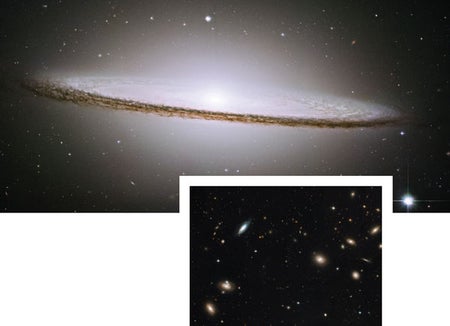
Ghostly Galaxies Appear in the Coma Cluster
Thinly spread galaxies caught on camera
After a Martian Marathon, NASA's Opportunity Rover Faces Uncertain Future
It's been a long time coming, but this week NASA's Mars Opportunity rover completed the first-ever Martian marathon. After landing on the Red Planet in January 2004 on a mission originally planned to only last 90 days, Opportunity has instead endured for more than a decade, and has taken eleven years and two months to [...]
Fact or Fiction?: Dark Matter Killed the Dinosaurs
A new out-of-this-world theory links mass extinctions with exotic astrophysics and galactic architecture
Dawn Spacecraft Arrives at Ceres, Becomes First to Orbit a Dwarf Planet
Shortly after 7:30 am Eastern time this morning, a seven-year space voyage at last reached its final destination: NASA's Dawn mission entered orbit around Ceres, a small, icy world orbiting the sun between Mars and Jupiter.
Why Space Stinks [VIDEO]
Parts of this supposed vast emptiness smell like rotten eggs or gunpowder.
Best Actor Eddie Redmayne on Portraying Stephen Hawking (Q&A)
Last night at the 87th Academy Awards, Eddie Redmayne won the Oscar for best actor for his portrayal of theoretical physicist and cosmologist Stephen Hawking in The Theory of Everything.
Stars Reveal Hidden Galaxy
A dwarf galaxy near the Milky Way may consist of more dark matter than regular matter.* Clara Moskowitz reports
The Universe's Oldest Stars Were Late Bloomers
The Planck satellite reveals the universe's first stars formed more than a hundred million years later than previously believed