
Space & PhysicsSeptember 24, 2010
Light-control measures appear effective near a key Arizona astronomical site
Light-control measures appear effective near a key Arizona astronomical site
Holst's Planets Revisited: New York City Band Follows in Composer's Footsteps
A new album from the group One Ring Zero envisions a journey through the solar system and beyond

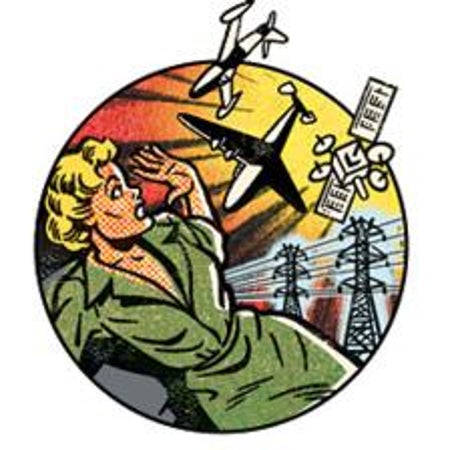
Laying Odds on the Apocalypse: Experts Assess Doomsday
Could modern civilization really come to an end? Experts take stock of eight doomsday scenarios
Recommended: The 50 Most Extreme Places in Our Solar System
Books and recommendations from Scientific American
Which Ray?: Conflicting Data on High-Energy Cosmic Rays Leave Their Source--or Sources--Unresolved
A new study proposes that ultrahigh-energy particles from space may have violent local origins, but not all observations are in agreement
Distant astrophysical beacons reveal masses of the solar system's planets
Slow and Steady: Astronomy Advisory Report Charts a Long Road for Exoplanet Science
The influential decadal survey champions the pursuit of potentially habitable worlds but offers few details for the near future
Influential astronomy priority list favors multipurpose telescopes
Report charts new course for US astronomy
Dark energy and exoplanets prioritized by decadal survey.
Volunteers' Idle Computer Time Turns Up a Celestial Oddball
Einstein@Home, a distributed computing project searching primarily for gravitational waves, has found its first pulsar
Origins: Going Back to Where the Story Really Starts
Sometimes we forget where a story really starts. Are electric cars new? Where did malaria start? Who invented spaghetti? Read on, for the surprising origins of many strange and familiar things
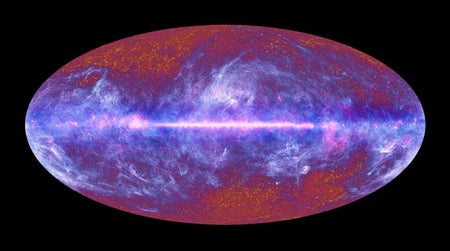
Planck spacecraft produces its first sky map
The European Space Agency's Planck mission team has released the spacecraft's first full map , charting the entire sky from August 2009 to June 2010.