
Luminary Lineage: Did an Ancient Supernova Trigger the Solar System's Birth?
A shock wave from an exploding star 4.5 billion years ago looks to have begun the collapse of the molecular cloud that formed the sun and planets
Luminary Lineage: Did an Ancient Supernova Trigger the Solar System's Birth?
A shock wave from an exploding star 4.5 billion years ago looks to have begun the collapse of the molecular cloud that formed the sun and planets
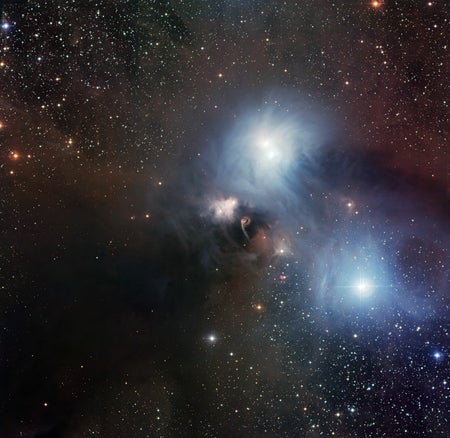
Wispy cloud illuminated by young stars in Corona Australis
This view from the European Southern Observatory's La Silla Paranal Observatory in Chile shows a nearby star-forming region, some 500 light-years away, in the constellation Corona Australis (the Southern Crown).


Some Milky Way Stars Are Survivors of Older Galaxies
Computer simulations show that stars of the Milky Way's halo originated in older galaxies torn apart by collisions. Cynthia Graber reports

Neutrino Mass Upper Limit Estimated by Galactic Distribution
Astrophysicists put the upper limit of the mass of the neutrino at 0.28 electron volt, based on the distribution of galaxies according to the 3-D Mega Z map. Steve Mirsky reports

Hayabusa spacecraft headed back toward Earth, perhaps with asteroid dust in hand

Shockwave reveals star's birthplace
Astronomers spy the trail carved through interstellar gas by a massive runaway.

12 Events That Will Change Everything
In addition to reacting to news as it breaks, we work to anticipate what will happen. Here we contemplate 12 possibilities and rate their likelihood of happening by 2050

Wayward Gluttons: Galactic Black Holes Can Migrate or Quickly Awaken from Quiescence
A pair of studies of galactic supermassive black holes reveals surprising properties and behavior

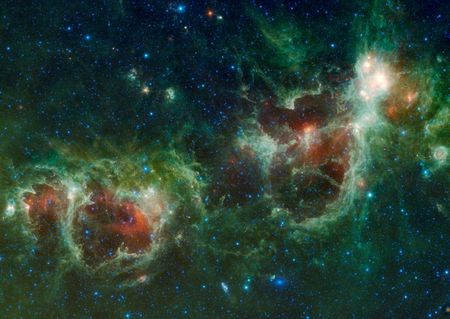
WISE satellite peers into Heart and Soul nebulae
MIAMI—A satellite launched by NASA in 2009 to map the entire sky in the infrared is capturing some pretty pictures along the way.

Primordial Gravitational Waves Provide a Test of Cosmological Theories
Cosmic inflation may have left a telltale imprint on the universe that could be detected in the coming years

Fermilab Finds New Mechanism for Matter's Dominance over Antimatter
An analysis of Tevatron data shows an asymmetry in the way particles known as neutral B mesons decay

Early Results from Large Dark Matter Detector Cast Doubt on Earlier Claims
The XENON100 detector in Italy should have been able to confirm previous dark matter signals